Thoughts on Dis-Enclosure

“It is unclear now whether extending the postdigital framework to embrace and understand conditions, behaviour, and societies outside Western Europe and the white settler nations, might not be an inappropriate attempt to create a neo-colonialistic rather than global way of looking at necessarily diverse and different communities and cultures, each with their own way of understanding their worlds and the impact of the digital upon them.”

John Traxler

I’m trying something new (again) and am articulating a response to a paper (thanks Paul) that Michalinos Zembylas had published earlier on this year. Am also responding to a conclusion that John Traxler drew in a piece seeking to reformulate the post digital in a more useful and inclusive manner (see quote above). I promised John some thoughts on Facebook, half way through last year (better late than never). Let’s see if anything coherent emerges from my “irrational” combination of two scholars thoughts.

John suggests that the assumptions underpinning accounts of “the postdigital” should be unpacked. He wants us to look at postdigital notions outside the heartlands of Western Europe and the white settler nations. Good point. I’ve been trying to understand and explain what the post-digital means in the context of South Africa. I’m seeing something quite odd. Post-colonial higher education systems, in my part of the world, are having their “predigital pedagogic conservatism reinforced” with “digital neo-colonialism”. Huh? Digital has become our “transmogrifier”, a device that transforms its user into any desired creature or item. Which is good for the individual who can be transmogrified. The rest?

John is spot on. Postdigital can generate yet another settler system of thought, and a common response to decolonize our knowledge systems is to be reflexive and recognize our position within the elites. This might be a misdiagnosis of the problem. Colonialism is not unique to Western Europe and hegemonic leaders always dominate with their discourse, no matter where they are located.
I think that Michalinos offers useful way forward with the following question….

Do proclamations of identity and positionality really challenge the epistemic legacies of Eurocentrism and push ‘non-western’ voices out of marginalisation.

Michalinos Zembylas

Does an excessive focus on “positionally” means that we essentialize ‘North/South’, ‘white/ non-white’ and western/non-western ‘elites/ non-elites’ binary thinking. Instead of making comparisons and placing ourselves in camps, perhaps we might be looking at our “socially constructed and multifaceted nature.”

I’ll give an example. The “performative declaration” of gratitude to First Nations that are often made by many colleagues and friends, leaves me feeling uncomfortable. Perhaps they’re a “false consciousness”. It reminds me of my student days when friends attempted and experimented with being far more radical than was permitted in their elite high school or what their parents would permit being discussed at home. These attempts, by the elite (me included), to resolve the contradiction between their identity as an ally of the marginalized, simply re-enforce the fact that, at least educationally and culturally, and often economically, we are privileged.” (Brookes, 2024) . These sincere intentions are entirely understandable, and we do need to make ongoing attempts to address injustice. However, the land on which these land statements are made, the quiet secluded studies where our online meetings happen and the excess of devices and options that we use to acknowledge the original ownership of the land. Makes the acknowledgement seem “insufficient”. Surely, if we are going to do land statements, then we should also have a property, a study and a device statement?

Perhaps our focus could be on Jean-Luc Nancy’s philosophy of being-in-common and the deconstruction (dis-enclosure) of Christianity?

What is disenclosure? “Déclosion finds it origins in works by Jean Luc Nancy?

The concept “disenclosure” is defined by Michalinos as “the opening of an enclosure, a worldview that is dominated by essentialised understandings of ‘western/non-western’ thinking or ‘white/non-white’ identities”. Michalinos begins his paper with the provocative question: He asks: whether a proclamation of marginal or privileged positionality really make a difference in de-colonial projects?

I understand the intent – to “decenter” the settler perspectives. To recognize that colonialism has shaped every campus and the worlds that we take for granted. But the discontinuity between the statement, the event, the medium and the language that is used to express this statement is so vast, it feels like a token gesture. Identity and land statements (to me) sound like an attempt to tame decolonization and absolve ourselves from being a part of the problem.

A while ago I enjoyed a lovely thread on Mastodon with a few friends. The topic began with thoughts about the enclosure of the human psych. We looked at readings to complement the discussion, and someone mentioned Hardin’s “The Tragedy of the Commons”. Jim argued very forcefully that this was a flawed paper. The Land Magazine agrees with Jim. They do point out that Hardin has “provided a template for understanding the enclosure [and inclosure] of other common resources”. Whether atmosphere, the ocean or intellectual property.

The words “disclosure”, “enclosure” or “inclosure” have a common root – “closure”. Simon Elmar points out that ‘enclosure’ and ‘inclosure’ are two similar and connected words, but there is a fundamental difference between them. An enclosure is a physical boundary that surrounds a portion of land. To enclose denotes the act of placing a boundary around a piece of land. Inclosure is a legal term that refers to the conversion of common land into private land. Private property is inclosed and any rights to land are severed. Inclosure is a legal process that ended the traditional rights to common land.

Enclosure is a physical boundary that limits access to a piece of land. Inclosure is the legal recognition of private property. In the UK, agricultural workers and tenant farmers were forced to find another way to survive, when their common land, on which they depended for their subsistence, was enclosed, using planted hedgerows. With parliamentary inclosure, under a “property-owning democracy”, nearly half the UK is owned by 40,000 land millionaires, or 0.06 per cent of the population (https://www.thelandmagazine.org.uk/articles/short-history-enclosure-britain).

In England, the hedgerows (enclosures) and statutes (inclosures) combined to create a landless tenant who worked for the lord to pay rent. These enclosures improved food security and caused an “agricultural revolution”. The parliamentary inclosures resulted in the expulsion of tennents and the landless proletariat that moved to towns. This urban labour force contributed to the Industrial Revolution.

I certainly can see similar patterns can be seen in South Africa. Colonists enabled Apartheid by enclosure and inclosure. I can also see during my time at Wits, I witnessed enclosure, with the formation of a new association and inclosure, with contractual arrangements with OPMs

John, post-digital allows me to look beyond my apparatus. But decolonization does not permit me to notices our digital enclosures (the gadgets, tools, devices and platforms) and knowledge inclosure (copyright and intellectual property) that are still here. Post-digital” is a reminder that there to look up, away from the screen. To be situated. Much effort is being made to position and configure this “digital everything” in particular ways. Binary thinking “Digital natives/ Digital immigrants”. “Technophiles and Technophobes”. Logged in and logged out. So, apart from adjusting to the digital world, we also need to see the paradigms or world views that are being built and maintained by those who have privilege and power. On screen, on campus and in law. Try to locate mindsets that have shaped the frame wherein I am pictured. 

The post digital turn has brought me to a place where I can’t avoid seeing the links between empires, hegemony, extraction and higher education. Whether the robber barons who established universities centuries ago, to produce elites. Or the Tin Temple(*), where I once worked, which was set up with mining money. New digital robber barons have simply replaced the colonial or industrial elite institutions, with enclosure of data on server farms They keep control of the data (inclosure) in data lakes where everything is IP protected.

A land statement in the context of webinar technology that is enabled by massive and powerful digital corporations and that we (me included) who are in the webinar are part and parcel those who benefited from enclosure and inclosure. Even when we challenge it. Does seem like an insignificant token or gesture.

Does Post Digital change anything?

As I read John Traxler and his critique of postdigital in Africa. I think he makes two excellent points.

1) “Post-digital” is a concept that comes from the metropolitan and industrial settings of the connected Global North, out of Western Europe and the white settler nations. He calls our attention to the strength and influence of Anglophone global. The digital corporations that are located in these countries and how private capital is taking advantage of the erosion or weakness of the nation-state.

2) The academic systems (publishing, rankings, etc) that are taken for normal in the post-digital heartland seem to be set up to intentionally misunderstand Africa. So whether it be “international publishers, national education systems or platform capitalism, or the roaming the global knowledge economy and the information superhighway”. The academic systems perpetuate dependency on foreign technology and expertise. This entrenches global technological and economic disparities.

This is the framework (perhaps ontology) that I think John is referring to. And it does not matter whether you are digital or post-digital. The ontological framework has not changed. So what are we to do? Well this is where I have been enjoying Michalinos Zembylas’s paper “Decolonisation as Dis-Enclosure: overcoming the dangers of positionality and identity in comparative education”. I think that Michalinos points to a very different way for framing coloniality. He ask us to see Achille Mbembe and the alternative ontology of decolonisation that he offers.

Result: So, I have chosen to listen politely to these habitual expressions of virtue, rather that exploring my reaction (let alone blog about it in public), Neither do I want to challenge the “virtue ethics” that lies behind these proclamations. I too am complicit with coloniality. I also confess my privledge (to make me feel better). The medium by which which I proclaim my education rests on coloniality. “Exploitation” is either designed into the screen. Or it is a feature of campus. Its especially notable online.

I choose to cling onto digital, as it has (temporarily) privileged me with shaping power. While a land acknowledgment might make one feel better about owning ones coloniality. The ideologies, values and prejudices, than under lie these beliefs. Are not countered or subverted. Perhaps colonial ideologies, values and prejudices are amplified by digital?

Learning: Michalinos’ paper, then is an opportunity then to make visible my “wince” or discomforted reaction to these “land statements”. No judgement. Perhaps to explore the tensions and contradictions that exist when the digital everything makes power even more asymetical?

In Michalinos paper, his suggestion is that we look at “being in common”. That we avoid simple binaries, and take a non identitarian perspective. Foreground a shared responsibility for a reparative future. A topic for another blog post?


Device Statement: My response is being composed interchangeably on an iPad and laptop. I am blogging on WordPress which I host on a shared server, located here in South Africa. I make use of my home WiFi, which keeps us all connected to information. I am writing this this post from my study in Johannesburg. The house was built in 1904, and was probably funded by mine capital. I don’t know much about the original inhabitants of this land. I try to be a good steward of all my resources.

References

Brooks, D. (2024) The Sins of the Educated Class. NY Times https://www.nytimes.com/2024/06/06/opinion/elites-progressives-universities.html

Elmar, S. (2017) In Defence of Our Land: Historical Similarities Between the Enclosure of Common Land from the Thirteenth to Nineteenth Centuries and the Privatisation of Public Land in the Twenty-First; or, Why the Class War Never Changes, Only its Historical Form. Available https://architectsforsocialhousing.co.uk/2017/05/04/in-defence-of-our-land-historical-similarities-between-the-enclosure-of-common-land-from-the-thirteenth-to-nineteenth-centuries-and-the-privatisation-of-public-land-in-the-twenty-first/

Hardin, G. (1968). The Tragedy of the Commons. Science, 162(3859), 1243–1248. http://www.jstor.org/stable/1724745

Traxler, J. (2024). The Postdigital Learning Spaces of Anglophone Sub-Saharan Africa. In: Lamb, J., Carvalho, L. (eds) Postdigital Learning Spaces. Postdigital Science and Education . Springer, Cham. https://doi.org/10.1007/978-3-031-59691-9_2

Zembylas, M (2024). Decolonisation as Dis-Enclosure: overcoming the dangers of positionality and identity in comparative education. 10.1080/03050068.2024.2326751

*Oops. Corrected Tin Temple – is the affectionate name given to the Transvaal University College”, which was split into the Transvaal University College (in Johannesburg which then became Wits University). While TUKS (Transvaalse Universiteits-Kollege) or Tukkies, is the affectionate name given to Pretoria University.

Whistleblower support in SA Higher Education

I spent a fascinating (and grueling) two days at UJ a colloquium, entitled “Breaking the Chains of Corruption: Whistleblowing as a Catalyst for Social Development in South Africa.”(18 – 19th July 2024) The event was dedicated to the very complex topic of “whistleblowing” and how the state and corporations have responded to corruption and capture.

Firstly, I was very grateful to Dr Ugljesa Radulovic and Dr Anthony Kaziboni for inviting me to attend. They put together an incredibly rich and diverse programme that had participants and presenters from all over the world (Canada, Greece, Ireland, Serbia, Netherlands, Portugal, Uganda, UK, USA and Zimbabwe). The range of perspectives was eye-opening. Many people who were there either supported whistleblowers, were whistleblowers themselves or were researching the whistle-blowing phenomenon.

I heard presentations of corruption in government (state capture), large-scale corporate graft (corporate crime) and environmental exploitation. I also recognized many of the themes and patterns. An individual recognizes that a line manager or boss is involved in llegal, immoral, illicit, unsafe or fraudulent activity and (naively) reports this information or allegation to a manager. However, instead of receiving support for this act, the individual who reports the misdemeanour soon faces retaliation from colleagues for their disclosure. They are then blackballed, their career is interrupted. Through a management procedure, they are suspended, sanctioned and dismissed.

I saw the importance of granting “whistleblowers” recognition (as opposed to expecting the whistleblower to exhibit resilience). I also realized the importance of giving Whistleblowers a voice. Whilst I enjoyed the proceedings enormously, I confess that I felt profoundly uncomfortable and unsafe in the academic space. Yes, this was perception on my part. There was an elephant in the room that wasn’t being addressed. This was “corruption” in higher education. While there were many other whistleblowers at the conference, there have not been many “academic whistleblowers” in attendance. Or none that identified themselves as such.

If you follow me on Twitter (or now X) and read my blog, you will see that I am both critical of tech’s place in education and also complimentary. I “call out” when individuals or groups experience harm due to ed tech. I also call in, but that’s not always visible. I am particularly concerned when externally funded groups use technology to initiate enclosure, perpetuate bias, discrimination and deficit thinking , or adverse inclusion. I do think that the extractive use of ed tech is responsible for schooling and higher education becoming a service or product.

In my nativity, I once saw Higher education is a “common good”. The digital doors of culture and learning could open. I sincerely believed that the internet made education accessible to more people. I thought that policies and devices could reduce inequalities and barriers to access (Boyadjieva, 2019). However, the current expanded access to higher education has led public higher education institutions to enter into public-private partnerships that have adverse effects. Whistleblowers allow higher education to turn their gaze on themselves. Whistleblowing researchers need to scrutinise the academy and management.

I left, resolving to have challenging conversations, to begin looking at the topic again. I thought I’d start by exploring whether whistleblowers were welcome in higher education?There have been very brave people and stood up to corruption in government and corporate. If higher education is serious about addressing corruption, then they need to protect whistleblowers. The question for me is, what are they doing to look after whistleblowers? I’m not pointing any fingers. Below are three Whistleblowing policies.

I also wrote a Wikipedia article about Universities South Africa (USAf), an association of Vice Chancellors, in which I called out some of senior management’s harmful behaviours. I’d be happy to have a “courageous conversation” with those who are open to having a conversation with me.

References

Boyadjieva, P., Ilieva-Trichkova, P. (2019) From conceptualisation to measurement of higher education as a common good: challenges and possibilities. High Educ 77, 1047–1063. https://doi.org/10.1007/s10734-018-0319-1

Harvard University (ND) Calling In and Calling Out Guide. Office for Equity, Diversity, Inclusion and Belonging https://edib.harvard.edu/files/dib/files/calling_in_and_calling_out_guide_v4.pdf

Research Data Management

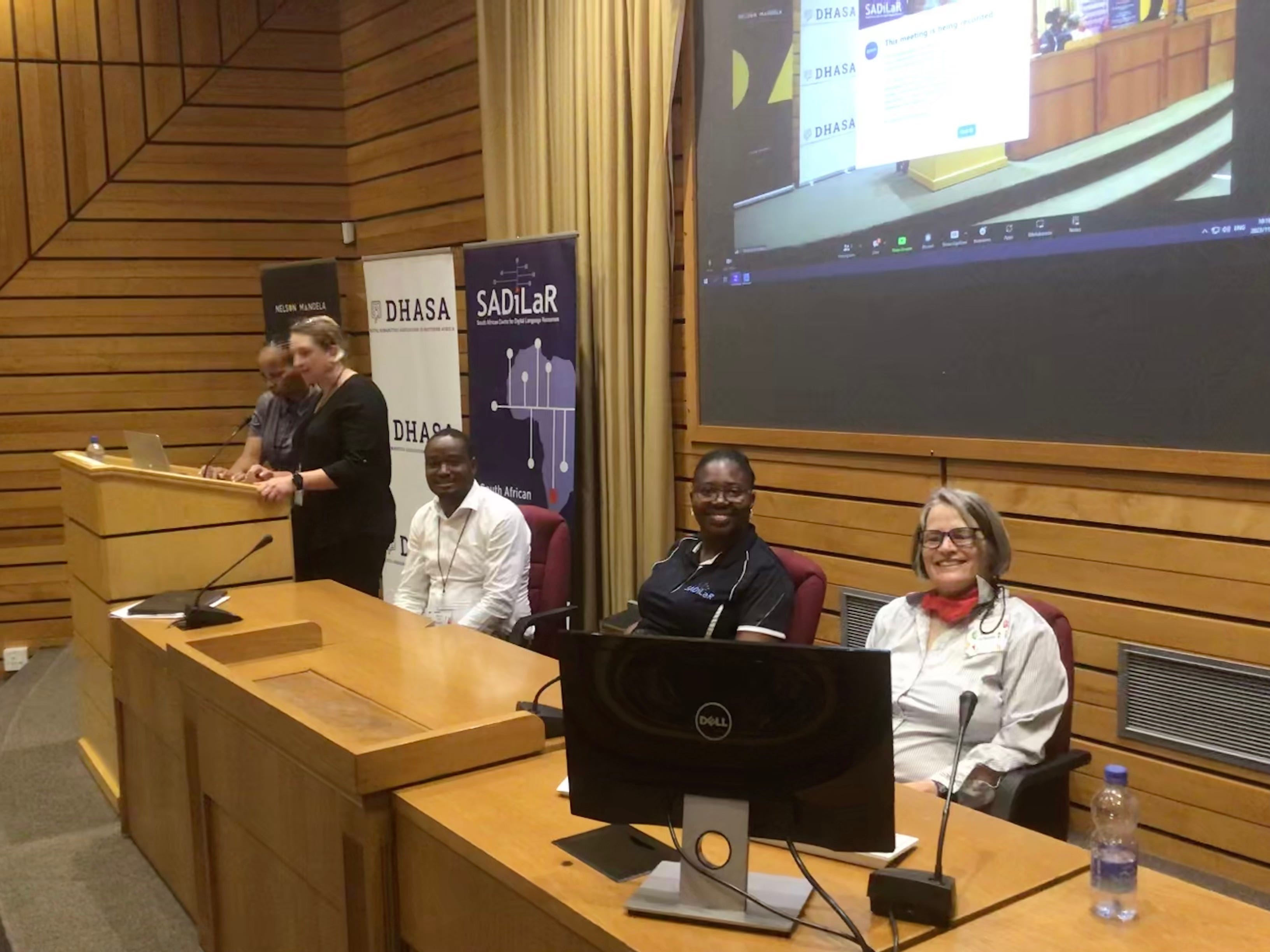
Spent the 13 -15th of November at Pretoria University at the Research Data Management workshop arranged by SADiLaR and run by the knowledgebase Benito Trollip and co-ordinated by the lovely Jessica Mabaso

Benito and I first met in person at DHASA 2023 in Gqeberha from 27 Nov – 1 Dec 2023 (almost a year ago to the day). At the conference I learned about the open-source translation tools known as the Autshumato Integrated Translation Environment (ITE) and saw the way in which SADiLaR staff ran their workshops, an approach I have always appreciated.

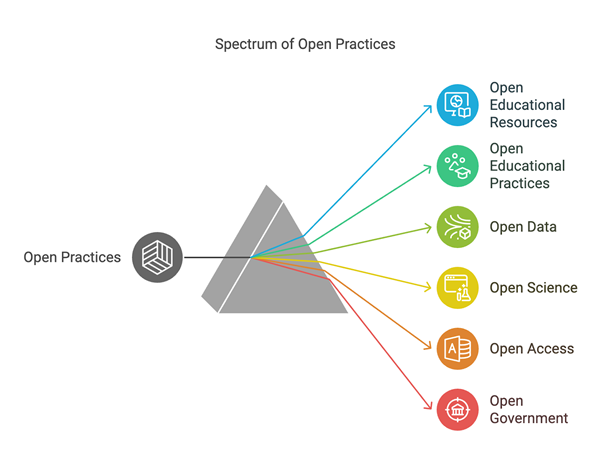
The day began with “construct your own curriculum”. We had interesting discussions about data and then moved onto metadata. We were introduced to Open Science, FAIR (Findable, Accessible, Interoperable and Re-usable) and CARE principles (Collective benefit, Authority to Control, Responsibility, Ethics) and data management. (FAIR and CARE seemed to correspond nicely with my CASEFULL acronym that I presented at a DH Ignite event last year). Benito covered topics such as Data Management Plans and the responsibility we held for managing our data and making sure data was good.

Probably the most challenging part of the workshop was Day 3 where Bianca Peterson (from Fathom Data) showed us how to use Open Refine (see the data carpentry lesson), for cleaning data. I’d spent days cleaning data manually for a client years ago. A thankless under appreciated task. This was an exciting tool to see in action and learn about.

If you do work with data and have the chance to attend. I’d recommend it thoroughly.

Highlights for me: Meeting and chatting with academics, librarians and other SADiLaR friends. Finding out about the SADiLaR Repository. Learning about more metadata techniques.

Show, tell, do and review

We’d like to celebrate you and your work. Give you the chance to stand (or sit) in front of others and talk about what you’ve learned. This is not a performance. Its the opportunity to show others a few examples of your work.

We’ll give you about 10 minutes for a “show and tell” session and you’ll have the opportunity to present your experience and expertise that would make you for the position. Be selective about your choices, we are looking for quality, not quantity. In the presentation, it would be helpful for you to show us work alluded to in your CV. While this is not an exhaustive list, you may include in the “show and tell” a few examples of your own work. This would include:

  • Demonstrable examples of engagement with discussions (formal and informal), at conferences, workshops, or online at a local or national level.
  • Electronic media/content designed for in class teaching or training workshops.
  • Electronic media/content such as presentations, films, audio, animation, websites, apps, ebooks, games etc. that may not necessarily be in a class.
  • Written or printed examples of your work such as proposals, website content, blogs, film/radio scripts, technical documentation, evaluations, reports etc.
  • Examples of work where you acted as consultant, mentor or champion.

Following your presentation, you may be asked to elaborate more on your pieces, the goals behind each piece of work (and your role in achieving them) and your own assessment of the work. Perhaps also speak about the conceptual and technical challenges associated with using this work in the intended setting.

My sell by date

The shelf life of an education resource (and the developer team) can be quite limited. As technology advances and digital fashions change every season, the primary decision facing the owner of an educational website often is “When must I bin my site“. I think an open course should rather be asking, “Who is the best person/partner to help you keep up with technology and the social web?” Some may think that digital transformation is driven by tech. Its not. Its ed techies who keep education resources alive and teachers who make the difference.

Here are 10 points to ask of your website and partner

1) How “findable” are you on the World Wide Web?

Go to a search engine and type in your organization’s name. Do you come up with the results? An you connect with some of the people who are mentioned on the site.

2) How “compliant” is your site?

Web standards are the infrastructural building blocks for the digital world. There are standards we take for granted in the physical world. And there are also standards that make it easier to find and share information on the web. Validation can help.

3) How responsive is your design?

Your web page will be viewed on different screens. Perhaps you might look at your pages at different page widths. A well-designed site will adjust according to the browser. A badly designed site will ask you to change the browser to look at it.

4) How intuitive is your navigation?

You will not be able to orientate people to your site. They will need to find their own way around. A consistent and clear navigation scheme, common conventions (clickable logo, breadcrumbs)  and clear signage can assist.

5) Do you have Terms and Conditions?

Many people are going to want to do things with your site content. Spell out clearly what they can do. The web is also social and if you choose to collaborate with others. Make the ground rules very clear for the community. Right from the start.

6) Are you giving to others?

It’s easy on the web to take other people’s hard work for granted. Sometimes we copy and paste ideas, or link to other sites without saying thanks.

7) How personable are you?

Every word and piece of code represents a system of thinking. Some choose to hide their digital identity (and have a good reason) and only share words and code. Others find safe spaces to make themselves known to others. They use images and language to connect and be personable.

8) Do you have a mentor or are you mentoring anyone?

Sometimes it’s better to model a good practice than to tell others what is better. Being a better model requires that you also find a model or a mentor.

9) Is there an archive your work?

Who is going to appreciate all your hard work, ten years later?

10) Solipsism and Narcissism happens

Watch out for imaginary friends. Get real ones.


The following educational resources (affectionately known as MOOCs) are no longer available. Pity

  1. Results-Based Project Management: Monitoring and Evaluation (Internet Archive – launched 5 Oct 2016)
  2. Research Methods: An Engineering Approach (Internet Archive – 7 Sept 2016)
  3. Introduction to Stewart’s Model of Physiological Acid-Base Chemistry (Internet Archive -)
  4. System Dynamics for Health Sciences (Internet Archive – 3 August 2016)
  5. Mining for Development: The Taxation Linkage (Wits News July 2020)
  6. Theory of Change for Development (YouTube)
  7. Media Freedom and Freedom of Expression in Africa (2018 Wits News)
  8. Forced and Precarious Labor in the Global Economy: Slavery by Another Name? (Live EdX)
  9. Digital Transformation and the IT Team (2018)
  10. Postgraduate Academic Literacy for Management and Business Students (Wits News Feb 2019)
  11. Academic writing for clarity and meaning (Internet Archive -)
  12. What do Architects and Urban Planners do? (2020)
  13. Civil Society and African Media Policy in the Digital Age (YouTube)
  14. Activism and Citizen Journalism through Media (Sept 2018)
  15. Civil society and African media policy in the digital age (Sept 2018)
  16. Decolonizing Evaluation (Nov 2020)

But this “MOOC” is still around. Not on EdX but on FutureLearn

EdX and MOOC Training

Please note: This was written by me December 2014, but I am only publishing it now (November 2024) on my blog. I think that the reflections are useful for those who want to run a massive online open course (MOOC).

In education, technology platforms have created expanded possibilities for teaching and learning. At the end of 2014, I flew out to Boston to attend the two-day EdX Training Workshop on the 18th and 19th of November and the EdX Global Forum on the 20th and 21st of November 2014. I had participated in the early constructivist MOOC (later dubbed cMOOC) when I was based in Pietermaritzburg. I was interested in how the academic heavyweights (Harvard, MIT) were adjusting to the social learning approach as they adopted a Massive, Open, Online Course (MOOC) format. I had also heard about MIT Open Courseware (perhaps through Derek Keats?). I wanted to visit their offices. To both pay respects to an awesome initiative and to learn. Then there was also MIT, where Seymour Pappert did his work in the application of computers in the education of children, and developed logo.

Boston is a bit like “Academic Disneyland” and I enjoyed exploring the location of the where the four-day event was held. The training they gave was useful. Krister and Teppo were our hosts, and they showed us how Americans ramp up a scaled-up course.
Some of the training was beyond my comfort zone, and I was pleased to have a manual. Americans always seem to have documentation that is far better than we do. Oddly, for an organization that proclaimed its openness, the course manual wasn’t licensed under a CC BY. Odd. Especially because of the MIT open courseware. But I also sometimes forget.

I did appreciate the workshops, as they had us work on their sandbox site, EDX101, before going live. The sandbox concept for a course was unfamiliar to me. Our LMS (Sakai) had a test server. But we did not do the same for courses. In retrospect, I could see the logic. It gave the course team the impression of an online course before they went about creating a course. It was also a helpful way to teach and explore all the features of the OpenSource EdEx platform before going live and clearing up any bugs, which can quickly wreck a big course.

After the two days of the workshop, it was time to go to the Global Forum—lots of noble ideas about education changing the world. I found myself far more interested in the traditional campus-based courses. External MOOCs were not our focus in the e-learning unit at Wits.

I saw how Harvard University and others experimented with SPOCs (Small Private Online Courses). These small and private courses were restricted access and only for paying students. SPOCs could support blended learning. The MOOC’s online resources and technology could be combined with the personal engagement between academics and students that in-classroom teaching provides. SPOCs and MOOCs were fed off each other. The SPOC would be located within the MOOC-created content. The academic teaching of the course could then draw on MOOC features and course content and utilise these resources with their campus students. The students could also contribute to the MOOC, which would be an amicable symbiotic relationship.

My most significant learning was not during the workshops or the global forum. Instead, it was about the importance of the programme manager who pulled things together, and the place where high-quality video plays in a MOOC course.

Offering a MOOC is a TEAM EFFORT requiring substantial contributions from many people in several different departments across the University. Programme managers play a crucial role in MOOC production. They require significant work experience in project or program management and online course development and are comfortable working in fast-paced, highly collaborative environments.

The key responsibilities of a Program Manager included:

● Serving as the primary liaison between edX and the member institution
● Managing all edX-related operations at the institution, such as selecting, building, and running courses
● Managing course project planning and project management
● Managing coordination and management of tasks, implementation, and post-project review and refinement
● Leading diverse project teams that work with academics, in addition to tracking and communicating project status to all stakeholders
● Responsible for creating and managing course access in studio.edge.edx.org

Video Production

MOOCs rely on multimedia extensively—not the 45-minute format that we usually associate with a lecture but short 5-9minute” lectures.” These lectures usually involve a combination of audio (capturing voice), screencast (capturing a computer screen with software for PowerPoint), demonstration, annotations, and voice, or video recorded in a dedicated studio or lecture venue (See pictures that follow).

After the event, I stayed in Boston for a few days. I realized that that MIT Open Courseware (ocw.mit.edu) had been producing open courseware for over ten years. With Clayton Hainsworth from EdX as my guide, I visited their studio. Here’s what I learned.

  1. The EdX studio is neither a large area (4 X 4 m) nor a high-tech space. Almost all pieces of equipment are portable. At the centre of the room are a podium, chair, lapel, boom microphone, and electronic pen. Behind, in the corner, is a large collapsible green screen. The lecturer can then stand or sit in front of a low-budget “green screen”, and video production software is used to superimpose lecture slides behind you.
  2. Lighting panels are on tripods, and LED lights are used, which reduces the heat, uses less electricity and are much more portable than traditional lighting rigs
  3. Tripods scattered throughout the room, some with LED lights on, some with microphones, and some unused. The walls behind the tripods are coated in fabric intended to dampen the sound. You can also see a whiteboard pictured behind the tripod. Whiteboards are tricky to film, so they suggested investigating a transparent surface.
  4. An autocue is set up for the lecturer. The one they used consisted of an iPad mirrored up at 45 degrees and a camera behind the mirrored image.
  5. The most complex equipment was in one corner of the room. It was a document camera mounted on a customisable stand with a camera and microphone. The purpose of this setup is to allow a student to view the lecturer working through a line of reasoning, but the feedback was that while hands make for a personal approach, it also is more difficult to edit with hands
  6. Although the room itself had its own editing table and computer, there was also a separate editing room where Britney showed me all the post-production work
  7. Finally, what held the whole lecturlet together was a storyboard.

The studio is not a high-tech affair, and it is set up so that the equipment can be moved to a lecture venue.

Equipment used for the lecturelet can be divided into three categories:

  1. Studio
    • 1 x podium
    • 1 x chair
    • 1 x white board
    • one electronic pen
    • 1 tablet
    • 3 x LED lighting and stand
    • 1 x boom microphone
    • 1 x microphone stand
    • 1 x portable microphone (parabolic)
    • 1 x popper/windshield
    • 1 iPad
    • 1 teleprompt
    • 1 green screen
    • 1 camera
  2. Screen-casting
    • An adjustable stand with writing surface, microphone and camera attachments
    • Large monitor
    • 1 electronic pen
    • 1 tablet
    • 1 Camera
    • 1 x portable microphone (parabolic)
    • 1 x Popper/windshield
  3. Post production area
    • 1 x 8 channel mixing desk
    • 2 x Desk
    • 2 x Chair
    • 2 x editing computers
    • Video and sound editing software
    • 2 sets of Licences for software
    • 4 x monitors

Sadly the training did not cover important matters like a the “data czar“, a person who could download and decrypt edX data packages. Neither were we shown the edX Data Package, which might have been very helpful for log analysis or formative assessment.

Perhaps this was what the 45 engineers at EdX were still working on?

Community Publishing

Photo taken of a “Public reading” sign (half falling down) at the Constitutional Court

I would assume that if a child has access to good schools and has a parent or caregiver(s) with an appropriate level of education….that they have access to a source of “cultural capital”. I might also assume that ongoing cultural capital investments would act as a possible predictor of the children’s future prospects.

My kids (well they are not kids anymore) have a background (middle class, english speaking parents) and location (suburban house close to schools, bookshops and libraries) as their habitus. I also assume that Bourdieu is also correct in seeing these two factors (location and background) as useful mechanisms for building and accumulating cultural capital.

Another predictor of a child’s future is “books in the home” (Heppt, 2020). The availability of a “home library” is estimated to offer a kid “3 years more schooling than children from bookless homes” (Evans et al., 2010). Books in the home environment makes reading possible. When these materials are shared, loved, read and renewed (if there is a library), when there is the space for literary games and or imaginative play. Then there is also a “cultural toolkit” where exposure, modelling and ongoing encouragement of reading are combined with cultural capital. Perhaps this is the habitus, where children’s “reading comprehension, reading behavior, mentalizing abilities, and expressive verbal ability” (Boerma et al 2017) is nurtured.

So its not only background and location that act as a future determent. There’s also the matter of book availability at home, the access to resources, whether they have reader role models around them to socialise them further into reading. We were fortunate enough (as a family) to surround our children with books, and we had the time to model good reading habits. We could also create an environment where attitudes and activities correspond with the literacy resources. Evans (2010) argues that a book-oriented home environment gives children a toolkit for “learning vocabulary, information, comprehension skills, imagination, broad horizons of history and geography, familiarity with good writing, understanding of the importance of evidence in argument”.

It more than developing a culture of reading, its more than offering a suitable tool kit. We also need to explicitly create a book-oriented environments. Whether its a room with book shelves, a flashlight set next to a bed (with a pile of books), a donation of a comfortable corner carpet and large cushion to the library, a small mobile library box in the park. A tablet / e-reader with a choice of suitable books. It’s not only the parent’s education (or the caregivers impressive CV) or the child’s alma mater that are indicators of future educational success. The milieu (physical and social settings) is also key. This is often taken for granted in my small corner of the world.

This is where social impact publishers, (African Story Book, Book Dash Nali Bali, Storyweaver, and Vula Bula) seek to use alternative approaches (such as social impact publishing or community publishing) to address the various issues. Whether it be the absence of a “cultural toolkit”, the need for book reading milieu. They open licenses offer cultural capital and the possibility for a book friendly milieu.

If they are making use of devices for reading, they are not peddling techno-solution. Rather, they are looking at means by which ALL those who are in the literacy project can get ahead. With our devices, I think that they find routes by which books can be brought into homes, read, enjoyed and valued. These books may be print books. But they can also be community books (https://en.wikibooks.org/wiki/Using_Wikibooks), classics in the public domain (https://www.gutenberg.org/) or ones that are sourced from social impact publishers.

Traditional books require a middle class market who can afford them. The books that are there are frequently not available in vernacular languages and many times books cannot be accessed by children and caregivers those whose homes are beyond the periphery of a library. Offering new way to access story books (print or digital) in the vernacular languages of children who are on the periphery is the next difficult step. But if we believe that reading is essential, that we need predictable access, then we have to find ways of creating language communities.

It may odd to hear an ed techie say this. But books are the best way to shape the future development of all children. Making diverse and appropriate books, written in vernacular languages, and sharing them in schools, public libraries, and homes, and online, seems an obvious route to reading. Yet, there seems very little progress in addressing the reading crisis. Why?

Even et al, in their article, mentions another term – “elite closure”. Myers-Scotton (1993) describes “elite closure” as a “social mobilization strategy by which those persons in power establish or maintain their powers and privileges via linguistic choices”. Ruling elites have for years, had power over schools and universities. English has a long imperial history, offered a means for the accumulation of social, cultural and economic capital. I have benefited from this “elite closure”. I look back at my attitude when I was expected to help others develop their digital literacy. I remember disagreeing with my colleagues, arguing that it was the responsibility of those who wanted to enter higher education, to be digitally literate. Evans dismisses the effects of elite closure on future predictability. I’m not sure if I agree. Have teachers of reading really considered how their own dominant language, their milieu, their cultural toolkit has offered them “cultural capital” or epistemological access. Have they considered adopting strategies to address reading equity?

Elite closure is manifested in other ways. The Central Jo’burg City Library has been closed since Covid. A partial re-opening is happening on Human Rights Day (March 21, 2025). The library closure meant that young readers, who were living in the city, could not access books. For five years, caregivers, who could model reading behaviour to those around them, were unable to go to the library.

Yes, the Lit District does make it possible to get books and bookshops like Bridge Books are doing amazing work in making materials available.

https://litdistrict.co.za/
The Lit District

As I see it, we have a compounding problem. There are not enough vernacular or local books written by mother tongue speakers. Libraries (that are open) are investing their efforts in digital capacity development (also in English). So we have lovely (and expensive) books, written in English, and available in bookshops. And we have digital literacy development, also in English. But elite closure means that current readers don’t see it as their responsibility to offer an on ramp to their milieu or (in some cases) to access to the the library . The cultural toolkit and milieu that is needed to learn vocabulary, assimilate information, develop comprehension skills, practice etc is limited.

So, I dislike criticality without agency. Perhaps this is the time for some local storytelling. A bookclub demonstration where we show young readers and (older) care givers how they might use some of these platforms and become pro-sumers. Enjoy the pleasure of doing their own book production. Those who have access and can use devices (and can see the need for children’s indigenous language) can use community publishing to address the book and reading divide.

Alternative publishers have considered how “books” might enable the teaching of basic skills, knowledge, values and practices…in a manner that respects children’s dignity and background”. These publishers are also aware of the need to enable epistemological access in schools, are comfortable with a variety of modes (eg books, mobile or open platforms) and often use Creative Commons licenses to share data, images, and text freely. Their texts are designed to be compliant and accessible. They can be used to address both formal and informal access to reading goods, and because they are “discoverable, accessible, and interoperable”, they can be accessed either by an institution or a traditional bookshop and distributed via wikipedia or digital means. We just need willing volunteers.

To sum up: We know that reading is in crisis. Location, background, access to books at home and at school can help children learn to read at age expectations. We have also know that there are other factors (language, teacher background, the school, parents and community) that influence reading development. While schools, bookshops and libraries cater to the reading needs of urban middle class children, the commercial book chain cannot cater alone for vernacular readers in the majority world.

We also know access to suitable books and a milieu can address the issue. We also have elite closure. Closures can be be addressed. You can assist by writing, illustrating, designing books! You can teach young people to create their own zine (a self published work, created because of passion for a subject). You can create an account on African Story Book Or run your own book making event .

Be interested to hear your thoughts.

References

“About us | Literacy Association of South Africa”. Literacy Association. Retrieved 2024-09-02.
Biesman-Simons, C. (2021-09-29). “Tracing the usage of the term ‘culture of reading’ in South Africa: A review of national government discourse (2000–2019)”. Reading & Writing. 12 (1). doi:10.4102/rw.v12i1.314. ISSN 2308-1422.

Boerma, I. E., Mol, S. E., & Jolles, J. (2017). The Role of Home Literacy Environment, Mentalizing, Expressive Verbal Ability, and Print Exposure in Third and Fourth Graders’ Reading Comprehension. Scientific Studies of Reading, 21(3), 179–193. https://doi.org/10.1080/10888438.2016.1277727

Evans, M. D. R.; Kelley, Jonathan; S.J.; Treiman, D.J. (2010). Family scholarly culture and educational success: Books and schooling in 27 nations. Research in Social Stratification and Mobility. 28 (2): 171–197. doi:10.1016/j.rssm.2010.01.002 . ISSN 0276-5624

Heppt, B., Olczyk, M. & Volodina, A. (2022) Number of books at home as an indicator of socioeconomic status: Examining its extensions and their incremental validity for academic achievement. Soc Psychol Educ 25, 903–928. Available doi:10.1007/s11218-022-09704-8.

Malada, B (2023-11-06). “SA needs to develop a culture of reading rather than boozing”. Daily Maverick. Retrieved 2024-09-02.

Myers-Scotton, C. (1993) Elite closure as a powerful language strategy: the African case International Journal of the Sociology of Language, vol. 1993, no. 103, 1993, pp. 149-164. https://doi.org/10.1515/ijsl.1993.103.149

Prah, K. K. (1999) The Post-colonial elite and African language policies . In. Comparative perspectives on language and literacy, p. 543-555 UNESCO Regional Office for Education in Africa (Senegal)

Shaver, L. B. (2015), Ending Book Hunger: Social Publishing and the Power of Mission-Driven Innovation (November 22, 2015). Indiana University Robert H. McKinney School of Law Research Paper 2015-47. Available at SSRN: https://ssrn.com/abstract=2694318

Openness and Intellectual Property Policy

Note to readers: I have been going through my blog and finding old blog posts that I had not published. This post was written in 2015 (I need to find the exact date), when I was working at Wits, but I have only published it now (August 2024).    

It’s easy to talk about sharing digitised teaching and learning resources. It’s trickier to consistently practice what you preach and license your intellectual and creative output appropriately. But it’s almost impossible to encourage others within your organisation to use /re-use / revise, / remix /redistribute Open Education Resources (OER) when your institution’s Intellectual Property Policy (IPP) does not addresses issues relating to the creation of OER resources and the licensing thereof.

The mission of the Wits is to grow its global stature as a leading research-intensive university and act as a gateway to research engagement and intellectual achievement in Africa. This engagement with others (in Africa and beyond) is governed by Wits’ Intellectual property policy (IPP). At present the IPP takes an “all rights reserved” approach to intellectual property and the policy sets out to protect the university’s interests using a fairly narrow framework. While the intentions of the IPP – whether they relate to copyright, trademarks, patents and other claims for ‘ownership’ of intangible assets – are intended to protect the university and academics from being exploited by other interests, the way that these issues around ownership, trust, provenance, attribution and risk are framed creates significant barriers to the open sharing of teaching and learning materials.
If academics are to be encouraged to freely share their teaching and further development resources then I think that it is necessary that the policy reconsider their current approach to ownership of IP. I think that the IP policy at Wits needs to make a distinction between
• the traditional results of academic scholarship, i.e. textbooks, literary works, artistic creations and artifacts and
• the novel results of research such as products, processes, machines, software, biological technology, etc.
Within the traditional group, IP rights should remain with the author(s) and the University rights are limited to free (no cost) use in teaching, research, extension, etc. in perpetuity. With the latter, IP should obviously remain with Wits.
Some institutions have made this distinction within their IP Policy. In a presentation by Laura Czerniewicz, entitled Openness at the University of Cape Town, Laura showed how they had approached the issue if IPP and OER. Their updated Intellectual Property (IP) policy now specifically addresses issues relating to the creation of OER resources and the licensing processes to be followed.
Notable aspects of the updated policy are
• UCT automatically assigns to the author(s) the copyright, unless UCT has assigned ownership to a third party in terms of a research contract, in:
• Scholarly and literary publications Paintings, sculptures, drawings, graphics and photographs produced as an art form
• Recordings of musical performances and musical compositions
• Course materials, with the provision that UCT retains a perpetual, royalty-free, nonexclusive licence to use, copy and adapt such materials within UCT for the purposes of teaching and or research
While not wanting to deprive the Wits of potential revenue derived from IP, if OERs are to become institutionalised, then it is also necessary that the present IPP be amended to offer academics the autonomy to value their own creative output and decide how they would like to determine the worth of their resources.

Anticipated outcomes of the IOL fellowship
Policy within a university is crucial for institutionalising and sustaining change. This proposal to join the IOL is so that the project owners may be equipped to prompt and assist those policy makers, lawyers and other affected by Wits current’ IP policy to address particular tensions that are barriers to greater choice and openness.

TEAL

Note to readers: I have been going through my blog and finding old blog posts that I had not published. This post about TEAL classrooms was written after I had visited Boston at the end of 2014 (I need to find the exact date), when I was working at Wits. I have only published the post now (August 2024). Still have to add photos.

As enrollment at Wits have grown, the teaching and learning infrastructure (lecture halls, libraries, computer labs) has had to expand to cope with larger student numbers. Larger classes require larger teaching venues, which means a bigger lecture hall with more tiers of seating and larger boards. There’s no doubt, that students, who have gone through 12 years of schooling, can grasp concepts more successfully when they are able to discuss and apply their thoughts through interactive, collaborative, student-centered learning. However, the architecture and design of current large learning spaces mitigate against this kind of learning and engagement between lecturer and students, in such large venue, suffers, simply because of the constraints that everyone find themselves in.

A classrooms that allows for conversations, should be designed to encourage students to meet face to face with their fellow students. So instead of making connections after class, via networked  media, students should be using technology at the same time as they are in conversations. Yes, out pedagogical models are playing an increasing role in design of the curriculum, but as yet, these pedagogical models have not called into question the eggbox and crate model of classroom design.

The Technology Enhanced Active Learning (TEAL) classroom is an exception to this rule. This structure is arranged and designed specifically to promote active learning in a large class setting. TEAL classrooms were spearheaded at MIT by John Belcher. They  offered students and lecturers an innovative educational method that facilitated collaboration and hands-on learning. This was assisted by technology, strategic design and rigorous assessment.

The TEAL studio flattened the lecture hall and made sure that the lecturer was not the focus of the class, as in traditional theater’s. The venue can accommodate 126 students and is specially equipped to support active and group learning. The room’s 14 tables each seat nine students and include video cables which can be used to project from students’ computers onto screens. The room includes five projection screens, 10 flat screen displays (corresponding to each of the student tables), and ubiquitous whiteboard space including eight whiteboards with dedicated video cameras. There are carts of laptops for students to use during class. An instructor station in the middle of the room controls which sources are displayed on the screens.

In the MIT TEAL classroom, the physical layout and technological setup of the room are designed to facilitate student-to-student, student-to-teacher, and classroom-wide collaboration. While I was at MIT I had the opportunity to observe a TEAL class in action with Peter . Nine students sat round 13 tables and the lecturer and assistants circulate and engaged. In Peter’s class I noticed that there were elements of lecture, discussion, hands-on experiments and feedback in one class. The lecturer was doing exam revision, and presented the class with discussion questions, visualizations, and pencil-and-paper exercises.

The design of the room supports a new style of teaching that encourages students to teach each other and solve problems in a collaborative way. The teacher becomes more of a facilitator and walks around between the tables. The room also has screens on every wall in the room, so that the classroom is able to shift focus to a specific group’s work or the teacher’s podium computer at any moment.

21st century technology, used in a 20th century learning spaces often reinforce this passivity. If blended learning is indeed to be a reality and the blend of online activities and face to face activities are going to be a good mix, then class time needs to be spent on tangibles, poderables and visibles where hands on activities and discussions can be designed to help them understand concepts. Lecturers in a teal classroom need no longer lecture from a fixed location, but walk around with a wireless microphone talking to students about their work, assessing their understanding, facilitating interaction, and promoting better learning.

Educational Futures (F1)

George, on his blog, asked “What are your reactions, thoughts, and feelings” to this educational futures scenario. Tried to post my reply in his blog comments, but got a technical error. So here is my blogged reply.

Future 1: The year is 2033. In the decade following the COVID-19 pandemic, higher education has increasingly become driven by collecting and analyzing vast amounts of student data, such as tracking student time online, physiological data, employment rates,etc. Learners attending public colleges and universities primarily pursue technical skills associated with a few streams of programs, including computer programming (such as the development of Artificial Intelligence and green technology), health, economics, finance, and business. The arts, social sciences, and humanities are no longer publicly funded. Learners can pursue such programs in expensive private universities, but only a few can afford them.

Veletsianos, G., & Houlden, S. (2024). Youth perspectives on three speculative futures for higher education. Journal of Open, Distance, and Digital Education, 1(1), 1-17. https://doi.org/10.25619/gv5shv76

Future 1 is an educational future that is dominated by “arrival technologies” and not “emerging technologies”. (https://doi.org/10.21428/e4baedd9.81164b06). As opposed to “emerging technologies“, that have to be consciously adopted, arrival technologies are just there to those who have devices, data and infrastructure. Arrival technologies work seamlessly, data driven and the quantification, and trackability make them an extremely attractive option to heads and administrators and those ed techies who think that these features are useful as evidence.

Sine they are cloud-based, arrival technologies work well with strong university brands. OPM’s can use “arrival technologies” to create a global reach (with a large number of international students subsidising declining local enrollments). Those of us who have been in the ed tech business for long enough will recognise the inevitable hype cycle and wonder when we will move from the peak of inflated expectations through the trough of disillusionment and onto the plateau of productivity. This old-school approach of waiting for the hype cycle to follow its course, might not work this time. The harms that arrival technologies might inflict on cognitive development, the teaching profession, knowledge and the environment (to list a few) are becoming very clear.

I am answering this question from South Africa, and have a slightly different perspective on educational futures (F1) down here. Arrival technologies have not had as big an impact on all universities. Arrival technologies, if configured for local users in vernacular languages, could offer epistemological benefits to those who have been previously marginalised or disadvantaged. This comment might alludes George’s second scenario, where universities become “hubs of local knowledge and places for community cultural and scientific development”. I’ll have to follow up.

George has a great set of references. Another set of University Futures worth looking are Near Future Teaching from Edinburgh Uni. You might also be interested in looking out for a special issue about “Fiction in Learning, Media and Technology Research