On the 25th Of July 2024, 2U announced that it was poised for growth, while it also declared Chapter 11 bankruptcy. According to the Wall Street Journal, 2U inc had “….taken private in a deal that will wipe out more than half of its $945 million debt”. 2U’s share price crashed and then the share price rose. There was some speculation about a “short squeeze“.
I’m not a stock market expert. I’ll leave that to Phil Hill. But I am intrigued in the confidence that Paul (CEO of 2U) exudes in their press release.
“Today marks an important milestone for 2U. New capital and a healthier balance sheet will enable us to continue our long-standing mission,”
Paul Lalljie, Chief Executive Officer of 2U.
While the company was going private in the US, it also advertised for 12 Positions in Cape Town.
Consensus On LinkedIn was that its “founders, from the very start, were clearly interested in benefitting financially. They grew it to a size that netted them a satisfactory financial return, and cashed out. Business as usual”. Or that the winners” here were two of the wealthiest institutions on the planet.”
These activities reminded me again about my MOOC / EdX experience. And I thought it would be good to jog my (and other readers memory), about how cMOOCs became xMOOCs (with EdX doing the business) and then how 2U took the model further.
The term “MOOC” was coined by Dave Cormier and Bryan Alexander. It was used to refer to a course developed by Stephen Downes and George Siemens entitled “Connectivism and Connectivity Knowledge”. Entry to the course cost in person students, but it was free to online students.
I had been a observer of the early cMOOCs, when I was based in Pietermaritzburg. The emphasis was networking and learning from other individuals, listening to different opinions, and forming one’s own. Just when I got to Johannesburg in 2010, I enrolled in #PLENK2010, but did not follow the instructions to introduce ourselves on Moodle. But choose to write my introduction on my blog, Lindsay Jordan left a comment
For a few weeks I was on a course with people like Dave Cormier and Stephen Downs. Two founders of the DIY constructivist version of Massive, Open, Online Course (cMOOC).
At the end of 2014, I flew to Boston to attend join the EdX event. There I attended a Training Workshop on the 18th and 19th of November and then EdX Global Forum on the 20th and 21st of November.
These seemed like heady days for online learning. Barack Obama announced an EdX White House Partnership, free training courses for teachers and free certificates.
Long before Adam Habib, signed up to the xMOOC on the 26 November, 2014, which he described as “a pioneering, innovative project spearheaded by Wits, which will indeed unlock new opportunities in South Africa and through the rest of the continent“, I had been playing with the format. When I heard, via the grapevine, that Wits was going to spend As a critical educational technologist, who was familiar with the movement, had written a piece about Wits and the MOOC.
Dropped the ball
In Feb 2015, the boss left. I assumed responsibility for three other T & D projects and a process to rationalise eLSI had begun. I had initiated a video studio, had purchased video equipment from and teaching and development grant for MOOC hardware… and were on our way to producing them…when things began to go pear shaped!
This post is a redraft from 30 July 2024. I’m going to describe the workshop that I facilitated. The title – “Ai Literacy: Telling your Ai Stories”. The workshop was part of the Serious Games Symposium held on the 17 September 2024.
The starting point for the morning’s session was an etherpad, a “synchronized notepad” that would be used for note-taking and collaboration. I first wanted to give workshop participants the experience of a structured conversation. Unlike Zoom chat, website chatbots or Generative Pretrained Transformers (Chat GPT), where a machine or a moderator determines what is seen or said. I wanted people to be free to understand and respond to questions. To use the etherpad to make their thinking visible.
I also explained that I would be wearing two hats. My authentic “Parisian Beret”, worn by hipsters and revolutionaries. Or my local 100% wool beret. Sold by Woolworths.
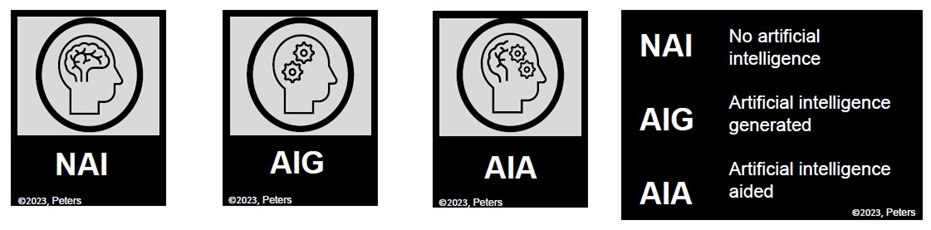
Participants were invited to create and tell two stories on a blog. One story would be Ai generated, while the other would be their authentic voice. I hoped to allow participants the opportunity to converse about and understand the many (dis)functions that come with “autonomous systems” especially when doing digital teaching. Ask questions as to whether ed-tech does deliver? And perhaps let us collectively gather our thoughts with conceptual tools that allow everyone to take agency, act and tell their own authentic story.
Derek Moore – Workshop Facilitator
Ai is contested territory, and some people sometimes get quite upset when Ai is discussed. We all agreed to a simple Code of Conduct that foregrounded our interaction.
Kindness
Intentional use of Resources
Fediverse First
Fellowship
Ai Literacy Task: Telling Two stories
My workshop began suddenly. The opening speaker did not pitch. I leapt in willingly, and introduce participants to the performance task. I asked them to tell two stories about Ai on a blogging platform. The one story would be generated by Ai The other story would be told directly by the narrator. The workshop would be performative. Participants could tell their Ai stories on their own blogging infrastructure.Those who complete their two stories on their a blog could also submit their Ai story to the Journal of ExoTechnology and Education!
Literacy once meant the ability to read and write. But with the emergence of new forms of media and platforms (like blogs), some have found it difficult to draw lines between reading, speaking, watching and writing (Korhonen, 2010) and thought an expanded understanding of “literacies” was needed.
I decided to begin our exploration of the topic of “Ai Literacy” in San Franciso. We tuned into Sophia Tung‘s “Self Driving Taxi Depot Shenanigans” video stream and the Waymo Honkingstory in a San Francisco charging lot.
There we saw an autonomous system that was interacting with the environment and learning through reinforcement. This allows them to complete an extended sequence of maneuvers. We also saw how these systems were disturbing the peace. Systems that were opaque, uncertain and emergent. On the ether pad I posted links to Sophia Tung’s video stream. And asked participants to answer the following three questions.
What’s going on?
Are self driving cars going to work?
You’ve had a seed of doubt or you might be wondering about?
Chat conversation was fabulous and comments were both funny and insightful and we laughed a lot. My favourite one was about Steve from Boksburg. Who decided to service his own self driving car and the chaos that might ensue.
I hoped that participants would begin thinking practically about Ai literacy, its purposes and the circumstances where it was important. I pointed out that Sophia Tung had been articulate and digitally literate to highlight that Waymo Cars (Google’s autonomous car system) was not working in her environment. She demonstrated her literacy on her Youtube livestream and community chat (the above TikTok is one of the reactions to her self driving cars stream).
When it comes to education and technology, I also think that we need to be critical about all autonomous systems. I adopt the following perspective…
“there is absolutely no inevitability as long as there is a willingness to contemplate what is happening”
— Marshall McLuhan, The Medium is the Massage
We then switched our focus from the future of driving (automated cars), to the future of teaching (education technologies). I asked participants to think about some grand technological visions. Like MOOCS, the 4IR or Ai in Education. Ask ourselves similar questions.
What’s going on?
Is education technology going to work?
You’ve had a seed of doubt or you might be wondering about?
You the StoryTeller
Our ether pad conversation then shifted then from self driving cars, education technology and onto ourselves, who would be telling our stories. I asked participants to describe themselves on the etherpad and how they pointed towards their digital selves. I asked a few questions and again we had some interesting replies.
What seven words would you use to introduce yourself as an academic to ANOTHER academic in an online space
If you had to create a sign post to your corner of the web? What would you write on the signpost
If someone asked you “Isn’t it narcism to put out your profile on the web?”, how would you answer them?
We also began to think about complicated words we use. Like “artificial intelligence”, “machine learning” or hallucinations. I suggested that we don’t always think about what these words mean and the implications behind those terms in our understanding of technology.
Our conversation was rich and engaging. And during this time I had been wearing my authentic french beret. But now it was time to look at our other story and put on my Woolworths beret.
1 | STOP – Ai should have a health warning
Just like many people once smoked, and didn’t consider the damage that was being done to their lungs or the people around them. I think that AI also should also have a health warning. Being knowledgeable requires time to combine words and language. We do research, add our experience and develop the capacity to articulate our thoughts. We become literate with pictures, words language and numbers. Becoming literate is hard hard work. Technologies have a history of making us seem both knowledgeable and knowledge-able. These tools and artifacts are helpful, but are also more than neutral things. They shape what we write, read and think. Impact what we perceive and do. Have a history. As we pursue the good life, we are being shaped by tools and technologies that have the capacity to do harm or negatively affect or benefit.
Technical glitches, Wifi connectivity and my ad hoc teaching methods, meant that we did not explore or investigate any of these themes properly. And so I felt that I did not get round to showing some of these excellent constructionist activities that Tom Woodward (I think) and the team created. I did however, haul out the ChatGPT. And showed participants, how I could get a story generated about me, using a prompt or two.
[INSERT Video about prompting]
Time began to run out, and I had not really finished part 3 and part 4. (See below). So I rounded the my workshop off with Postman & Weingartner’s Teaching as a subversive activity and a small video
There was lots that I did not say in the workshop. I would have loved to cover the following two points
3 | FIND OUT – The Do’s and Don’ts When Using ChatGPT & Similar LLMs
4 | TRACE BACKWARDS – What’s your digital story. Are you the autonomous narrator of your Ai story? Or is your “tech-positive” story narrated for you? Are you crafting stories from your story telling toolkit, or is the platform shaping your story? (thanks McLuhan)
I still would also like to award a Digital Badge to those can show and perform their two stories at a post workshop meeting (date to be decided).
Biesta, G. (2015). How Does a Competent Teacher Become a Good Teacher?: On Judgement, Wisdom and Virtuosity in Teaching and Teacher Education. In R. Heilbronn & L. Foreman‐Peck (Eds.), Philosophical Perspectives on Teacher Education (1st ed., pp. 1–22). Wiley. https://doi.org/10.1002/9781118977859.ch1
Brint, S. (2016). Thinking about Schools and Universities as Social Institutions: An Intellectual Self-Portrait. In A. R. Sadovnik & R. W. Coughlan (Eds.), Leaders in the Sociology of Education (pp. 37–55). SensePublishers. https://doi.org/10.1007/978-94-6300-717-7_4
Korhonen, V. (2010) Chapter 10 – Dialogic literacy: A sociocultural literacy learning approach, Editor(s): Annemaree Lloyd, Sanna Talja, Practising Information Literacy, Chandos Publishing, Pages 211-226, ISBN 9781876938796, https://doi.org/10.1016/B978-1-876938-79-6.50010-8.
Lu, C. (2024). Rethinking artificial intelligence from the perspective of interdisciplinary knowledge production. AI & SOCIETY, s00146-023-01839–2. https://doi.org/10.1007/s00146-023-01839-2
Matthews, A. (2023). The Mode 3 Network University and Design: A New Materialist Perspective. In N. B. Dohn, J. Jaldemark, L.-M. Öberg, M. Håkansson Lindqvist, T. Ryberg, & M. De Laat (Eds.), Sustainable Networked Learning (pp. 189–209). Springer Nature Switzerland. https://doi.org/10.1007/978-3-031-42718-3_11
Nørgård, R. T., Mor, Y., & Bengtsen, S. S. E. (2019). Networked Learning in, for, and with the World. In A. Littlejohn, J. Jaldemark, E. Vrieling-Teunter, & F. Nijland (Eds.), Networked Professional Learning (pp. 71–88). Springer International Publishing. https://doi.org/10.1007/978-3-030-18030-0_5
Omizo, R., & Hart-Davidson, B. (2024). Is Genre Enough? A Theory of Genre Signaling as Generative AI Rhetoric. Rhetoric Society Quarterly, 54(3), 272–285. https://doi.org/10.1080/02773945.2024.2343615
Pierosara, S. Narrative autonomy and artificial storytelling. AI & Soc39, 1785–1794 (2024). https://link-springer-com.wikipedialibrary.idm.oclc.org/article/10.1007/s00146-022-01595-9
Rata, E. (2021). The Curriculum Design Coherence Model in the Knowledge‐Rich School Project. Review of Education, 9(2), 448–495. https://doi.org/10.1002/rev3.3254
Whittaker, Meredith, The Steep Cost of Capture (2021). Meredith Whittaker. 2021. The steep cost of capture. interactions 28, 6 (November – December 2021), 50–55. https://doi.org/10.1145/3488666, Available at SSRN: https://ssrn.com/abstract=4135581
*
More Details
Title: Serious Games and AI Symposium Date: 17 September 2024 online
P. S. Please note that I am an Ai Sceptic. But I am also drawn, like a curious moth, to most emergent technologies. I use Ai, I think that it holds some promise for language development in the majority world. I also acknowledge the ethical debt that accumulates with my experimentation. I too am a part of the apparatus.
(Please note, this interview took place on the 06 March 2014. Details may have changed since the interview)
For the past six years, the online educational company Get Smarter has partnered with the UCT Faculty of Commerce to offer a range of online short courses. UCT’s website lists the following short courses offered in 2014.
Marketing (Internet Marketing, Marketing, Copywriting for Online Marketing, Public Relations, Sales Management, Social Media and Foundations of Advertising)
Management (Foundations of Corporate Coaching, Operations Management, Supply Chain Management, IT Management, Advanced Project Management, Human Resource Management, Project Management Foundations, Training and Development Management)
Business (Applied Economics for Smart Decision Making, Digital Photography, Events Management, Feature Writing, Guest House Management, Internet Super–User, Professional Communication and Office Management, Office Computing, Photoshop, Tourism Management, Graphic Design, Residential Letting, Screenwriting, Web Design, Commercial Property Broker, Copy–editing and Web Development)
The average price for a course is in around R9 500. Get Smarter courses are offered exclusively online – in 10-week to 12-week blocks. There is no final exam and short courses are not accredited by the Higher Education Quality Committee (HEQC), but students that complete the courses (Get Smarter claim a 95% pass rate), receive a UCT short course certificate of completion or a certificate of skills validation There are no admission requirements to these courses, except for access to a computer and internet connection, as well as the ability to read, write and complete any assignments in English.
I contacted Sam Paddock, co-CEO of Getting Smarter s, via Twitter and he and I had a 45 minute conversation about Get Smarter and their approach.
Collaboration
Sam stressed that this was a collaborative partnership – primarily between the UCT Commerce Faculty and his company. UCT does not pay Get Smarter for any bespoke work but share in the profits of their work. As far as I am able to ascertain, the partnership works in the following manner. UCT acts as the academic custodian responsible for academic content, recommending appropriate academics for the and quality assurance. Get Smarter takes responsibility for learning design, multimedia development, administration, support and managing the learning management system.
Marketing
While UCT do list the above Get Smarter courses on their Continuing Education and Professional Development at UCT, it is apparent that Get Smarter play a very active role in marketing the courses. Sam indicated that Get Smarter itself run a full in-house advertising agency and, as a member of the Get Smarter mailing list, I have been impressed by their comprehensive and accessible promotional campaigns across a range of different media.
Learner management & Support
Get Smarter manage the admissions process. Applications for entry to courses are online. As there are no entry requirements for a course, authentication documentation is not necessary, and entry is granted once payment has been made. Get Smarter use Moodle as an LMS. Sam made an interesting observation during the interview when he remarked that he didn’t consider their Learning Management System to be a key differentiator. He indicated that what set them apart from other local e-learning short course providers is the “High Touch” approach they take to online relationships. It is apparent that engagement between course participants, course convenors and course administrators is high. If Get Smarter have a key differentiator from their South African competitors , then I think it is their approach to Social Presence
Course structure
Get Smarter’s short course are not associated with UCT’s semesters and are scheduled independently. Courses are offered over 10 to 12 weeks, each week is considered a module and 7 hours work per week is expected from students.
Course structure is a standard formula with a combination of
• Course Notes
• Course Videos
• A quiz
• Discussion forum participation
• An Assignment
• Further reading materials
Costing
Sam, understandably, was reluctant to share course production costs. He and I discussed global course production costs and he indicated that Get Smarter’s production costs were an eighth of the standard average. The development costs of developing an online short course are certainly higher than the costs involved in developing a traditional classroom based course. UCT does not however, have to make any upfront investment as Get Smarter and UCT Faculty of commerce are in a partnership agreement. These costs for Get Smarter are offset by possibilities of large numbers of participants and lower human resource costs as many of the people involved are part time employees of Get Smarter.
What is the cost of a course for a student? I’ve gone through all the courses offered in conjunction with UCT and it seems as if the average price is R9 500. See attached spreadsheet
How much does the average course cost Get Smarter to produce? Sam was reluctant to share with me the cost of producing a course. He and I discussed average course production cost – somewhere between $2 000 000 (Coursera’s stated price) and $15 000 (MIT’s stated price). He indicated that Get Smarter’s production costs were an eighth of the price of a Coursera course
What is the minimum amount of students that you will accept on a course? Sam indicated that courses were popular. He said that they accept no less than 30. He indicated that course numbers could go up to 200. They have 5000 students going through their courses every year.
What is your ratio of student to facilitator? A course has a course convenor (the UCT presence). Subject matter experts do the teaching and engagement and a course co-ordinator who acts as a facilitator and assists with social presence / support / encouragement. Technical support is also available.
How long, and how many people involved in getting the average short course together ready for students? I did not get a reply
Where do the different responsibilities lie. Who is responsible for the curriculum content, the “instructional” or learning design and “digitization” of content? Get Smarter takes responsibility for most of the above
How do you assess student’s mastery of what they have been taught? Are your assessments continuous and with no final exam? There are assignments associated with each module within a course. Assessment is based on the assignment
Who is responsible for student admissions and certification? Get Smarter take responsibility for admissions. Certification is provided by UCT’s Short course administration. Certificates have not got any accreditation with HEQC
Apart from expertise, what do you expect from your subject matter experts? Subject Matter experts are very busy people and Get Smarter make sure that their company takes care of the learning design, multimedia production and student coaching
What quality assurance processes are in place to ensure the content is correct and student performance is satisfactory? This is the responsibility of the course convenor
Are your certificates SAQA aligned? No
What training do you offer your subject matter experts, course facilitators and support? In house training for our 120 full time and 60 part time staff
Note: This interview with Sam took place on the 06 March 2014, after a Tweet to Sam Paddock. It is being republished, for those who continue to be interested in the Get Smarter Model.
Am I a little too late for the party? Sorry. I’m often delayed. I do see that I am permitted to build custom versions of ChatGPT. Thank-you. Before purchasing any package, I prefer to “try-before-you buy”.
Yes, asking AI a leading question is a klutzy hack from journalism 101. Anyways, I asked Chat GPT two questions. About the neuromyth called learning styles. The idea goes individuals each have a preferred “bucket” or style (i.e., visual , audio, or tactile) for learning.
The “advice” ChatGpt gave was contradictory. Which answer do you believe? (My answer is below the table).
Hey ChatGPT “You are an educational expert. Create a blog
post about learning styles“
Hey ChatGPT “Should I match my lesson to children’s
learning styles?”
Understanding Learning Styles: A Comprehensive Guide
In the realm of education, understanding learning styles is
pivotal for both teachers and students. It is the key to unlocking
each individual’s potential and ensuring that knowledge is
effectively absorbed and retained.
Learning styles refer to the preferred way in which individuals
absorb, process, comprehend, and retain information. This concept
is grounded in the idea that everyone learns differently, and by
identifying and catering to these differences, educational
experiences can be significantly enhanced.
The Major Learning Styles
The most widely recognized framework for learning styles is the
VARK model, developed by Neil Fleming. VARK stands for Visual,
Auditory, Reading/Writing, and Kinesthetic. Each style represents
a different sensory approach to learning.
Visual Learners Characteristics: Prefer to
see information and visualize the relationships between ideas.
They often use diagrams, charts, and written directions.
Effective Strategies: Incorporate
graphs, flowcharts, videos, and other visual aids into
lessons. Encourage the use of color coding and mind maps to
organize information
Auditory Learners Characteristics: Learn
best through listening. They benefit from discussions,
lectures, and audio materials.
Effective Strategies: Use podcasts, group
discussions, and verbal explanations. Encourage the use of
mnemonic devices and read-aloud sessions.
Reading/Writing Learners Characteristics:
Prefer to interact with text. They excel through reading and
writing activities. Effective Strategies:
Provide access to books, articles, and digital text. Encourage
note-taking, journaling, and creating lists.
Kinesthetic Learners Characteristics: Learn
best through hands-on activities and real-life experiences.
They enjoy movement and physical engagement with the learning
material.
Effective Strategies: Incorporate labs,
field trips, and role-playing activities. Encourage building
models, drawing diagrams, and other tactile activities.
Beyond VARK: Other Models and Theories While VARK is a popular model,
there are other theories and frameworks worth exploring.
Howard Gardner’s Multiple Intelligences
Gardner’s theory posits that there are various types of
intelligences, such as linguistic, logical-mathematical, spatial,
musical, bodily-kinesthetic, interpersonal, intrapersonal, and
naturalistic. This model suggests a broader understanding of the
diverse ways people can be intelligent and learn.
Kolb’s Experiential Learning Theory This model emphasizes learning as a process where
knowledge is created through the transformation of experience. It
highlights four stages:
Concrete Experience,
Reflective Observation,
Abstract Conceptualization, and
Active Experimentation.
Learners may have preferences for different stages.
The Importance of Recognizing Learning Styles Understanding and recognizing learning styles is crucial
for several reasons:
Personalized Learning: Tailoring education
to fit individual learning styles can improve engagement and
retention of information.
Increased Motivation: When students are
taught in a way that aligns with their preferred learning
style, they are more likely to be motivated and enthusiastic
about learning.
Improved Performance: Students often
perform better academically when they are allowed to learn in
ways that suit them best.
Lifelong Learning Skills: Awareness of
their own learning preferences helps students develop
effective study habits and lifelong learning skills.
Practical Application in the Classroom Implementing learning styles in the classroom requires a
dynamic and flexible approach.
Diverse Teaching Methods: Employ a variety
of teaching methods to cater to different learning styles. Use
multimedia presentations, interactive activities, and written
assignments to reach all students.
Assessment Variety: Use different types of
assessments to allow students to demonstrate their
understanding in ways that suit their learning style.
Feedback and Reflection: Encourage students
to reflect on their learning processes and provide feedback
that helps them understand their strengths and areas for
improvement.
Adaptability: Be willing to adjust teaching
strategies based on the needs and responses of students.
Flexibility is key to accommodating diverse learners.
Conclusion
Learning styles are a fundamental aspect of effective education.
By understanding and incorporating various learning styles into
teaching practices, educators can create a more inclusive and
effective learning environment. This not only enhances the
educational experience but also empowers students to become
confident and self-directed learners. As the educational landscape
continues to evolve, embracing and adapting to different learning
styles will remain a cornerstone of successful teaching and
learning
The concept of matching lessons to children’s learning styles
has been a topic of considerable debate in the field of education.
While the idea of tailoring instruction to individual learning
preferences is appealing, recent research suggests that a more
nuanced approach might be beneficial.
Here’s a detailed examination of why you should consider but not
rigidly adhere to matching lessons to learning styles.
Benefits of Considering Learning Styles
Increased Engagement: When lessons incorporate
elements that align with students’ preferred learning styles,
students often find the material more engaging and accessible.
Diverse Teaching Methods: Acknowledging learning
styles encourages teachers to use a variety of instructional
methods, which can help address the diverse needs of all students.
Self-Awareness: Helping students understand their
own learning preferences can promote metacognitive skills,
enabling them to become more effective, self-directed learners.
The Limitations of Strictly Matching Learning Styles
Lack of Strong Evidence: Research has not
conclusively shown that matching teaching styles to learning
styles improves learning outcomes. Studies suggest that the
effectiveness of instruction depends more on the quality and
appropriateness of the content and pedagogy than on aligning with
specific learning styles.
Over-Simplification: Learning styles theories
often categorize students into specific types, which can be overly
simplistic. In reality, students benefit from a blend of
instructional methods and may not fit neatly into one category.
Fixed Mindset Risk: Emphasizing learning styles
can inadvertently promote a fixed mindset, where students believe
they can only learn effectively in one way. This limits their
ability to adapt and develop new strategies.
A Balanced Approach Rather than strictly matching lessons to learning styles,
consider a balanced and flexible approach that incorporates
elements of learning styles theory while focusing on
evidence-based teaching practices.
Strategies for a Balanced Approach
Multimodal Instruction: Use a variety of
teaching methods to address different sensory modalities. This not
only reaches students with different preferences but also helps
reinforce learning through multiple channels.
Visual: Incorporate diagrams, charts, and videos.
Auditory:strong> Use discussions, lectures,
and audio recordings. Reading/Writing: Provide written materials and
encourage note-taking. Kinesthetic: Include hands-on activities and
movement-based tasks.
Differentiated Instruction: Differentiate your
instruction based on student readiness, interest, and learning
profile. This involves providing multiple paths to learning and
allowing students to choose how they demonstrate their
understanding. Offer choices in assignments (e.g., write an essay,
create a presentation, or develop a model). Use flexible grouping
for activities based on students’ needs and strengths.
Formative Assessment and Feedback:
Regularly use formative assessments to gauge student understanding
and adjust instruction accordingly. Provide feedback that helps
students develop a growth mindset and explore different ways of
learning. Use quizzes, polls, and discussions to check for
understanding. Provide constructive feedback and encourage
reflection on learning strategies.
Encourage Metacognition: Teach students to think about their own learning.
Encourage them to try different strategies and reflect on what
works best for them in different contexts. Promote goal setting
and self-assessment. Discuss various study techniques and their
applications.
Create an Inclusive Learning Environment:
Foster a classroom atmosphere that values diversity in learning
and encourages students to support one another. Encourage
collaborative learning where students can learn from each other’s
strengths. Celebrate different ways of thinking and
problem-solving.
Conclusion
While considering learning styles can enhance engagement and
diversify teaching methods, it’s essential to focus on a broader
range of evidence-based instructional strategies. By adopting a
flexible, multimodal approach and fostering an inclusive, adaptive
learning environment, you can support all students in reaching
their full potential. The goal is not to match lessons rigidly to
learning styles but to create a rich, varied educational
experience that prepares students for lifelong learning and
adaptability
Who do you believe?
ChatGPT has left me a bit bewildered. Not surprising though. The answers given are not about accuracy, the research or the truth. This Ai is built on a large language model LLM’s. That have been compared to a stochastic parrot, which can string statistically probable words and sentences together, this creates an impression of intelligence and reason for a reader. In reality this statistically predictive text on steroids, does not really have a clue as about the topic, that it’s squawking about.
Brain research has resulted in a neuroboom (Grospietsch & Mayer., 2019) and neuromyths, (misconceptions about neuroscience) contain kernels of truth about “brain based learning” (Touloumakos et al., 2023). These kernels are often transferred into pedagogical practice. Yes, people might have visual, auditory, kinesthetic (VAK) preferences for learning. But changing a modality in your teaching to match learners’ preferences and to cater to their “learning style” is a misinterpretation of the facts. Which chatGPT excels at.
References
Grospietsch, F and Mayer, J. (2019). “Pre-service Science Teachers’ Neuroscience Literacy: Neuromyths and a Professional Understanding of Learning and Memory”. Frontiers in Human Neuroscience. 13. doi:10.3389/fnhum.2019.00020.
Touloumakos, A. K., Vlachou, E., & Papadatou-Pastou, M. (2023). “Visual type? Not my type”: A systematic study on the learning styles neuromyth employing frequentist and Bayesian statistics. Mind, Brain, and Education, 17(3), 197–208. https://doi.org/10.1111/mbe.12380
On Thursday, 16 May 2024, I ran a webinar about Academic Blogging for early career researchers. Prof Mpho-Entle Modise (from SAERA) arranged the event. These are my post-webinar thoughts.
Dear academic bloggers,
I am very grateful for your time and attention in this academic blogging webinar. Thanks so much for allowing me to both confuse and enlighten. My apologies for the former. I didn’t want to follow the same webinar formula. Zoom fatigue is real. I don’t like dull.
What matters is the creation of a thoughtful architecture to support inquiry, reflection, conversation, and so on. The ratio of brick to click —as education is increasingly hybrid now in any case—is not the deciding factor
I do hope what I showed you might catalyse further discussions about making your thinking visible via a blog.
I think that blogging is both a way to break out of our academic bubbles and connect to those who can’t read paywalled journals. It also offers an alternate route to find other academics, who share your interest. Or even other jobs.
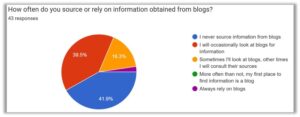
I’ve started to realise that not many people in Higher Education in SA have an academic blog. Most of my examples of academic blogs come from overseas. Here in South Africa, off the top of my head, I can think of Paul Prinsloo, Michael Rowe and Laura Czerniwicz . To help me judge immediate familiarity with the format, I conducted a survey beforehand about participants’ knowledge and experience with making thoughts visible. The results from the study about blogging were fascinating (summary generated with the assistance of ChatGPT).
40% of academics never consult blogs.
76% of participants do not have a blog but some expressed an interest in starting one soon.
A few had blogs but were not consistent with updates.
Participants seemed curious about the benefits and implications of academic blogging, especially in relation to publishing and career development.
They also were unsure about the differences between blogging, social media accounts and professional networking site such as LinkedIn.
Many thought that blogging was a good way to share research and ideas with a broader audience and make their academic work more visible to the broader public. .
Some are interested in finding strategies to be more consistent and to manage the content focused on their academic interests.
After the presentation (to be added after clean up), I left time for Questions and Answers where I tried to share some of the lessons I had learned from my blog
�| Q and A
Q: What would the benefit be for a teacher / educator to blog?
Teachers and educators are at the coal face of education. They do incredible work with very little public acknowledgement for their efforts. Many do share their stories on social media because that’s where the clicks and likes lie. Blogs, however, are a better place for teachers (and their students) to tell their stories in their own words without being gamed by an algorithm or captured by big tech. Blogging also forces you to learn new media skills.
Q: Academics need to reach out. Dedicate time to op-eds about essential topics that align with our work
Agreed. This is especially hard when you are stretched, and the question is where to begin. My response is that I want to own my own digital infrastructure, where I post my thoughts. Then, I cross-post thoughts to other public engagement platforms. I license my work as Creative Commons, allowing another publisher to use my work.
Q: I would like to know what this involves and the value of it. I would like to understand the implications of academic blogging with publishing and how it could help create an online presence and if it can in any way enhance developing an academic career.
Creating a digital footprint for yourself does require effort and a bit of shameless self-promotion. I sometimes feel pretty uncomfortable with the SSP part of my work. We usually only see value in economic terms, but value can also be seen as social capital.
You tell your colleague about the new restaurant nearby the office (and she takes you for lunch) .
Your colleague keeps the department journal running, this work builds a small community of academics who look out for each other in other ways, and credibility for the person running the site
In distance education, the psychological and communication space between teachers and students is called the transactional distance (see Michael G. Moore). This space needs to be crossed, as this is often a space of potential misunderstanding between the academic and student. There are many ways to bridge this transactional distance. Blogging is one of them. So yes, the value of putting your thoughts out outweighs the embarrassment of spelling mistakes or incoherence (which you can correct later).
.
Q: I would also like to understand the difference / pros and cons of this online presence vs posting on LinkedIn
Blogging and LinkedIn are not exclusive, and both can be used. I’ll give you the cons. There are too many pros in the world.
The cons of blogs are that they initially attract much lower traffic, the audience who reads them is usually narrow, there is a technical learning curve to having a blog site, and the challenge of finding a voice.
The cons to Linkedin: According to the T & C, you have granted Linked In a non-exclusive right to use the information and content you share on their services. LinkedIn gives you exposure and is an excellent networking tool. However, your own identity is ultimately subsumed by the LinkedIn brand.
Q: Just like any platforms whether it social media, or anything similar, what are some of the dangers that could be associated with academic blogging?
Much has been written about the dangers of social media. There is a war of ideas on the net. This is a very underregulated environment, and certain voices are much louder than others.. I like the SIFT method to determining what I can trust or not. This heuristic has been useful to me when addressing possible dangers.
Q Where can you choose and buy a domain name for a blog?
Q: In terms of funding, since hosting a website or blog has some expenses attached to it, would one be able to include academic blogging (and the maintenance of the site) as a Science Engagement expense when making grant funding applications?
Yes, hosting a blog involves some expenses. If you are at an academic institution with access to multiple servers, I suggest that academics be given server space to host their educational services and platforms.
Public funded institutions should commit to supporting a Digital Public Space. These are the spaces for connection and exchange. The physical doors to learning and culture shut down years ago. Higher education could still offer this digitally. Such a space is possible on campus. This would address the problems that crop up when domains expire. When that expiry happens, someone can buy the domain. Click on the supplied URL to see what happened to The UnbundledHE project
Q: Would you advise having one’s blog link shown on their twitter account
Yes. My Blog is the hub. Twitter, Instagram, LinkedIn Tiktok et are the spokes
Wordcloud from the question: What do you hope to gain from this webinar?
Final thoughts
I am very interested to see that 40% of academics in the survey indicated that they never read blogs. This is a big surprise to me. Yes, blogs are not peer-reviewed. However, peers do read them. I have found blogs to be one of the better primary information sources from researchers who are usually at the cutting edge. Academic knowledge would be better if they combined blog reading and scholarly publications.
If you are not an academic blogger. What can you do? Here are 10 steps you can take.
Choose and buy a domain name
Find a web hosting service (I can help with that)
Find good open-source software to help you host your blog (I use WordPress)
Learn how to optimise files and how to transfer them (so that they don’t take too long to download. Especially for students on mobile pay-as-you-go data)
Get rudimentary HTML, CSS or markdown right. (I suggest a cheat sheet. Meta (now on WhatsApp can be a surprising assist)
Learn how to do basic image editing or image sourcing
If you use Creative Commons resources, cite your sources correctly.
Check for errors. There are many opportunities for them to creep in. I am a prime example here.
Academic blogging has been an essential part of my ed techie / Instructional designer life since 2005. I’d like to suggest that academic blogging is a useful “bottoms up” strategy for creating digital footprints, for remaining accountable for your thoughts. In the neo liberal-university, where ” learning is only understood in economistic terms.” A scholar is often positioned as a “Brand”, that managers are looking to monetize. Education technology is the route by which this value is extracted and academic publishing is the mechanism by which this “brand” remains visible in the institution.
I think that’s a mistake. If you really want to encourage critical thinking, then this thought should not only be done within the academy. But be done openly. Higher education institutions should encourage their early career researchers, to own a domain of their own, develop their own identity and find their voice.
Start collecting and articulating your own ideas. Be bold and share them. Either in vernacular language to sustain and grow thought. (see Mthuli’s blog https://www.mthulibuthelezi.com/ ) Or in a dominant language, (like English) to develop social capital. Perhaps you might want a multi user blog, like FolioFriday. I want to know….
Should you permit the intrusion, I might respond to your research with my comments, ingesting what I read, synthesising what you’ve said in my blog and adding my subjective experience. There is so much that I don’t know about you and until I set about collaborating on something specific with you, dear blog reader, that allows our minds to meet, it’s going to be my untested set of assumptions about you that guides my writing.
I don’t know who you are, dear blog reader. And despite what I’ve written. Neither do you know me. Are we only going to know each other when we are in the same room that we open our respective experiences, thoughts and reflections to each other? But perhaps we can we begin to know each other beforehand and understand our differences and shared interests after reading each other’s blogs? Each located on our own domains? Where we can build an accountable identity.
Yes, there are both benefits and challenges of blogging. When’s the best time to plant a tree? Yesterday. When’s the next best time to plant a tree? Today. When’s the best time to begin enjoying the benefits of blogging? Want to learn more. Sign up to my newsletter?
I was so pleased to be invited to assist the SWiP language preservation initiative and contribute and facilitate on their authorship training programme. I joined the SWiP project team and we ran three workshops in the central region, where we honed our Wikipedia skills (researching, markup, translation). We brought together communities and (hopefully) began to encourage language communities to make it a habit of of contributing to the preservation of culture, histories, identities and language on Wikipedia.
The word SWiP is a combination of three organizations SADiLaR / Wikipedia / PanSALB. These language preservation Wikipedia workshops were held all over the country. I assisted with those which were hosted at VUT, TUT and UNISA (the central region). A big thank you to all the academics and librarians who joined us at these events. Quite astonishing how two letters, can change your Wikipedia experience..
Everyone responded so enthusiastically over the two days. Was also impressed with the progress made by participants.
SWiP is working on a mission to preserve and promote South African languages through platforms like Wikipedia. Wikipedians like Bobby Shabangu, Matete Lesele, and Herschall Jackson (and me), are assisting the advancing vernacular languages use on Wikipedia.
More than a reference resource
Wikipedia is more than just a free online encyclopedia. Wikipedia is really all about the many Wikipedian communities worldwide who are striving to represent “the sum of all human knowledge” and fill in the many knowledge gaps. The cultures of these Wikipedia communities differ, but they have five pillars.
Five Pillars of Wikipedia
Wikipedia is a free online encyclopedia. Both free as in free-speech and free as in free-from-cost (like free beer)
Wikipedia is written from a neutral point of view.
Wikipedia is free content that anyone can use, edit, and distribute.
Wikipedians should treat each other with respect and civility. Always assume good faith.
Wikipedia has no firm rules. “Be Bold.”
Douglas Ian Scott advised me to be bold. Don’t be afraid to make mistakes (but always learn from them). Disagreements happen, what is important is how we settle disagreements. That’s where the Wikipedia culture helps.
Renewable Assignment
I’ve written a few articles on Wikipedia. This one, about “Renewable Assignments“, is perhaps one for South African Wikipedians who are part of a language community. Essentially the idea is that a renewable assignment allow for feedback to be incorporated. They offer the student a choice of topics, or even allow the student to choose what they will write about. Renewable Assignments can also be about collaboration in the field and the willingness to make this information open to others. This is possible in all of the languages of South Africa.
I’ve been awarded a Creative Commons Certificate after attending the June 2020 Creative Commons (CC) Copyright Course. (Yes, I realise that this is old news).
I am a consistent advocate for openness. I find myself regularly recommending CC licenses as a viable alternative to traditional copyright protection. Open licensing allows ed techies to strengthen their collective efforts. This approach is especially relevant in under served communities and allows all to build a more equitable, accessible and innovative world, through open sharing of knowledge and culture.
I use CC licenses with clients, both the operational level, to help the people I’m working with to understand copyright issues and alternative means to manage their creative outputs. And at a policy level, giving guidance about suitable versions of the license for the institution.
“Zoom University” by Weblearning shared under a Creative Commons (BY) license
I graduated from the Open Seeds Cohort 8 in January 2024. What a pleasure to learn again.
Since leaving Wits, I’ve become very critical about online learning. I often focus on how tech and education became dominated by technology evangelists selling hype or on senior management outsourcing core skills to online program managers (OPM)s. I’ve also had enough of other open practitioners benefiting from my free labour. My grumpiness got channeled onto Twitter. It seemed to me that the formula for learning, in the last decade, had grown stale. Perhaps I got myself into a rut?
Expectation of the programme
Open Seeds pulled me out of my funk and furrow. The OLS leaders, cohort colleagues and my wonderful mentor, reminded me of my earlier enthusiasm and optimism for learning online. There were some like minded academics, that saw digital as a mechanism for thoughtful enquiry (and not just content delivery).
Goals for my project
The project that I chose to work on, was the Open Umbrella (OU). This resources was initially designed with Detken Scheepers from Pretoria University. The initiative emerged after fees must fall. It was also supposed to be used for TVET staff development. I had hoped to make the OU, a place for collaboration, sharing alternative ideas and supporting new practices around digital education. It’s wasn’t a solution. It questioned how physical and digital learning (or hybrid) spaces are configured, are used. Teaching and learning now take place in an age of information abundance. I had hoped that the open umbrella would encourage academics and students to re-imagine learning, foster new skills, enable different capabilities, and let us set new priorities. This was supposed to be where we collaborate across the global (or at least the local) education and technology community. Where we all could be co-creators and curators of knowledge, share feedback and experience with others. In a safe way, where we all are open, considerate and respectful. But there had not been much progress with vision or roll out thus far.
Key understanding
My new mission was to stop developing the resource itself further. My task now, was a call to action among educational practitioners. To gather a community. Whether they identify as educationalists or technologists. I had to begin locating people who wanted to
lead and assist with a community of Ed / Techies who are unfurling the open umbrella on GitHub even further
Desired Outcome: The formation of a cohort of digital education champions who can contribute towards making critical use of digital resources and craft quality digital teaching and learning experiences
Derek’s new goal
What has changed?
The sixteen weeks on Open Seeds were a refreshing experience. I had to re-articulate my vision to others. I heard input from notable experts on topics I had not considered. Surprisingly, I realised that Open Seeds had begun to shift my practices. For the first time, I saw the sensible use of an etherpad (what a fabulous alternative to the LMS). As a platform, Slack became a propper “water cooler”—a much more productive gathering point than Twitter.
Since the course has ended, I’ve enjoyed exploring ways to combine WhatsApp, the etherpad, and a framework called Systems Convening with a project I’ve been working on in Malawi. I’ve also tried out the etherpad with Wikipedians in the local public library, run storytelling and showcase events and offered an in-person workshop with University of Johannesburg educators, and all Q and A were on the etherpad (with chocolates as an additional incentive).
What now?
What intrigued me most about the Open Seeds mentorship experience is a question. How do you operationalised this approach, which worked so well in the northern hemisphere, here in higher Education in Southern Africa?
A local vision
I think that all ed techies and instructional designers in an institution can (and should) contribute to developing expertise within a university or school. Instead of starting from scratch or looking to the global north for answers. I think that those who work with this resource, need to build upon a pre-existing course and demonstrate a familiarity with open education resources and open practices. Mentors will guide involved parties through the concepts, processes and techniques in the field guide and apply them to the platform where the course resides. Developers will set the scope, self-identify their immediate challenges and choose to focus on eight practice areas. By the end of the a set mentorship period, I anticipate that developers will be able to
use open education resources (OER) and be familiar and comfortable with open education practices (OEP)
share their newly found expertise openly on a suitable platform(s)
connect with a community of practitioners across other projects, faculties, schools and departments within their university and beyond
Showcase their work in a public event.
I hope to empower new online education champions so that a community of critical instructional designers and innovative users of education technology can lead, improve, and sustain change. I wish to enable independent people, from all background and identities. Meet regularly over a set period of time (as a cohort) and find others who want to mentor individuals, where they can receive advice and guidance from domain experts.
Envisioned Process: A cohort of selected developers will be mentored through structured activities drawn from the Open Umbrella and become digital education champions and ambassadors for the platform they are working on.
Derek’s new direction
Gratitude
These are my thoughts about my 16-week cohort and mentorship journey. As you can see, my “sprint” with the Open Life Sci crew has been unusually transformative. I’d recommend this 16 week sprint experience to anyone interested in opening up themselves and their academic practices to critical scrutiny. My thanks to Anelda (from Tlarify), who introduced me to SADiLaR and brought me onto Open Seeds. She also employed me to run a local project called DH OER. I’m extremely grateful to her, SADiLaR team, for a shift in direction. My thanks also are extended to the OLS team, their marvelous example, and Harini (my mentor). For all these efforts. I am grateful.
Below, please take a look at my final presentation.