Wikimedia and Public Libraries

I’m not a regular Wikipedian (yet). Most of my efforts to open up ICT for Education (ICTE) are focused on OER projects such as OE4BW, DH-OER, Creative Commons or mLiteracy. But last year, Paul West passed on an invitation to attend the Wikimedia strategic retreat at the Constitutional Court and attend the annual AGM as the Creative Commons representative.
At the risk of stating the obvious…
Wikimedia is a global movement whose mission is to bring free educational content to the world. Through various projects, chapters, and the support structure of the non-profit Wikimedia Foundation, Wikimedia strives to bring about a world in which every single human being can freely share in the sum of all knowledge.
I joined the South African chapter of Wikimedia and assisted them with their thinking about their 5 year planning. I found it fascinating to be thrown into about the inner decision making body of this largely unfamiliar organization. Through Creative Commons and Open Life Sciences, I have been introduced to a code of conduct for remote meetings. But here, we had an in person meeting with a code of conduct. Many of my academic friends could learn from that.
In South Africa, under the leadership of Bobby Shabangu, Wikimedia have been doing amazing work on projects an number of projects. I’m going to highlight two
- The promotion and preservation of indigenous languages by means of digital technologies (SWIP)
- A campaign to introduce librarians to Wikipedia and encourage collaboration between the two.
SWiP Project
I am particularly interested in this collaborative initiative to preserve indigenous languages by the South African Centre for Digital Language Resources (SADiLaR); the free encyclopaedia (Wikipedia) and the Pan South African Language Board (PanSALB). Wikipedia aims for a world where every single human being can freely share in the sum of all knowledge. But at present Wikipedia is mainly available in dominant languages. Wikimedia South Africa are promoting the growth of Wikipedia in all of the languages of Southern Africa.
Wikipedia loves Libraries
Then because of my work with City of Johannesburg (COJ) and the mliteracy work I have been doing in public libraries, I have also been pleased to participate in their Wikipedia loves Libraries campaign. Since the Strategic Planning Event in November 2023, we have held one mLibrarians and Wikipedians event at the Randburg Library
It has become increasingly clear to me, as an open educator and a critical ed techie, that the devices that we hold in our hands and the information that is shared via networks and platforms can be used to share the sum of all knowledge in my own home language (English). However, there’s so much more work to be done on making this true for other language groups in this country and on this continent. Public librarians, I think, hold the key to making this possible.
DH-OER | Its a Wrap
Digital Humanities has delivered 14 new Open Education Resources (DH-OER). These projects are about
- multilingualism
- open education practices
- new media pedagogies
- foundational literacies
At a “gala” event (on Zoom), champions and their team members contributed towards the DH-OER Champions Showcase and Celebration event.
Personally, the DH-OER project has been a marvellous journey for me. Although I only stepped in towards the end of the project (see introductory blog post from July 2023), I met almost all of the DH-OER leads in the first month or two who were drawn from universities across South Africa. I also noticed how some champions began taking ownership of their digital identities and opening up their educational practices to the world. The Digital Storytelling Workshop (and my rubbish attempt at a Pecha Kucha) was also embarrassing but fun. And now, as the project ends, I’m encouraged by the collaborations developing between champions and a growing interest in the Digital Humanities in South Africa from all over the world.
Time Line of the DH OER Journey
Certificates for participants have (finally) been sent out. This round of the project is complete. The H5P timeline (see above) recounts the two-year journey that began in December 2021 and culminated in November 2023. The github file (see below) contains details about the final showcase presentations.
https://github.com/Web-learning/DHOER
I’m happy with what was accomplished by all the champions. However, as you can see from the timeline, this project was too drawn out. The current DH OER model is much too extended. Some improvements can be made to the timeline and milestones. With Anelda’s help, I’ve been looking to https://openlifesci.org/openseeds/ for guidance on running a structured open education programme that encourages sharing, connecting and empowering within a set timeframe. I’ve also penned a project report. SADiLaR can do the following.
- Consider what they have learned by running this experience,
- Start a set of critical conversations about the way this particular project was formulated, structured and executed, and
- Discover ways to make the project sustainable and continue contributing positively towards subsequent DH-OER development.
Digital Humanities is only at the beginning of its Open Education Resources journey. OERs need to become an accepted and recognised part of their academic project in South Africa. SADiLaR has an opportunity to strategically build upon the champions’ experiences over the past two years. Perhaps it can model itself around initiatives like “Open Seeds” or Mozilla Open Leaders. Create a structured, responsive, and effective mentorship programme staffed by a team that will guide and socialise OER champions through the concepts, processes, and techniques of using and developing open education resources. We can use what was learned this time to improve the project’s next iteration.
Thanks to all who joined me on this journey.
Unfurling the Open Umbrella

I find myself, once again, in the midst of yet another inconvenient ed-tech storm. Currently, a tempestuous AI cloud, has cast a dark shadow. Its “bluster” has exacerbated existing ICTE challenges and blindsided many schools and universities. Prior to AI, the tempest rolled right through my windows. It saturated my families home screens. Unexpected campus closures led nervous administrators to enable Zoom University and it’s partner – Emergency Remote Teaching (ERT) (Hodges. 2020).
This two and a half year downpour of webinar after webinar, undermined years of research in online education. Well thought through practices and theories were replaced with a poor substitute for the classroom and the LMS. Before that, in my home country. A Twitter hashtag #feesmustfall, created a high pressure system of student and academic activists. Who sought (legitimately) to gather their efforts on social media and decolonize the curriculum. But there efforts were quietly hijacked by OPMs. Promising to extend access and opportunity, while gutting internal capacity by outsourcing. Their extreme disruption still leaves its trauma stamped on higher education. A decade ago, the forecast for the future was all MOOCs, promising to make higher education more accessible to the masses. The New York Times is still getting it wrong.
My point? AI, ZoomU, OPM’s and MOOCS. Four examples of the vast and deadly rot that has rained down and seeped into the universities infrastructure. Induced and supported by vast FAANG monopolies. That prefer to buy out the competition and remain under regulated. The ongoing “enshittification” of digital education (Doctrow)
The Open Umbrella is my (and a few other collegues) small imperfect response to these massive rigs. Its an attempt to gather critical educators. Who see the ongoing attempts of big tech (and political actors). Who wish to make platforms to reconfigure governance and frame public education as a new asset class (Willimanson). This call to unfurl the open umbrella, is a call to those who still wish to use tech to collaborate, co-design, educate. But would prefer to remain independent of the big tech’s rigs, clouds or administrator’s convenient STI. Techies, educators, hopepunks. Outliers in the fediverse who see through the hype and attempt to steer themselves , classes and their technology.
Instead of being shaped by networks and connectivity and its assumed global benefits to all in education. And being underprepared for the capricious weather forecasts, supplied by Big Tech and their VC seeded clouds, offering alternative intelligence, virtual classrooms, a social learning environment, unfettered access to knowledge. Or the techno determinists influencers. Who want change, but who are unashamedly techno deterministic. The open umbrella seeks to offer shelter to those who wish protection from the many disruptive clouds, its seeders and associated storms.
The Open Umbrella consists of a self evaluation tool, field guide and open badges. A team of educators can use the Open Umbrella to “protect themselves from the storm and resist it’s shaping effects. The Open Umbrella remains a nascent initiative that offers an imperfect shield with eight panels. The umbrella ribs creating a scaffold for collecting open education practices. And then adapted and developed for their their own customised course. While being recognized for their efforts.
This Unfurling the Open Umbrella workshop is more than just an attempt to question and evaluate the benefits of technology in education. Its also an attempt to be weather ready. Instead of being underprepared for the next storm. The open umbrella can assist those who wish to be pro-active and ready for the next disruption. To pull together and decide on alternatives.
Whether it be LLM’s and its anthropomorphising of chat, surveillance capitalism, checking on student participation. Or social media, gaming out attention spans. The open umbrella offers alternatives to those who have been disrupted. A space to gather together and collaborate on teacher or evidence led options
References
Bender, E.M., Gebru, T., McMillan-Major, A. and Shmitchell, S. (2021). On the Dangers of Stochastic Parrots: Can Language Models Be Too Big? Proceedings of the 2021 ACM Conference on Fairness, Accountability, and Transparency. FAccT ’21. New York, NY, USA: Association for Computing Machinery.
Birch, K. (2023) Assetization as a mode of techno-economic governance: Knowledge, education and personal data in the UN’s System of National Accounts, Economy and Society.
Doctorow, Cory (2023). “As Platforms Decay, Let’s Put Users First”. Electronic Frontier Foundation.
Hodges, C., Moore, S., Lockee, B., Trust, T., & Bond, A. (2020). The Difference between Emergency Remote Teaching and Online Learning. EDUCAUSE Review.
Morozov, E. (2013) To Save Everything, Click Here – The Folly of Technological Solutionism. New York: PublicAffairs
Williamson, B. (2023) The power of edtech investors in education
https://codeactsineducation.wordpress.com/2023/11/03/the-power-of-edtech-investors-in-education/
DH-OER Champions Showcase & Celebration

I’m preparing for the DH-OER Champions Showcase and Celebration happening next week. You are invited. Click on the above link to sign up.
Spoiler Alert. If you read further, you’ll be able to read my welcome and introduction (still in draft). This is what I’m intending to say at the welcome on the 16th of November.
Welcome and context setting
Dear DH OER Champions
Today is your day. In a ridiculously short 15 minutes, you are going to be showing us the fruits of two (or more) year’s worth of your labour. We can only but scratch the surface of your efforts.
Programme leads and teams will be either playing us a pre-recorded lighting talk. And / or chatting about the experience of developing an OER. You are encouraged to participate. Whether it be on the backchannel (on Zoom chat). Or using the hashtag #DHOER on the platform that is your digital habitat.
This is the first time the South African Center for Digital Language Resources have run the programme. I think that many have discovered that producing an Open Education Resource (OER) is hard work. It has a technical element that requires a deep understanding of copyright law, licenses, devices, platforms. And it has a personal dimension that requires a willingness to be an agent of change and grow one’s own digital capability.
This work is also going to be available on the SADiLaR website. It will refer visitors to your repository and also to the lighting talk video that you made. So readers and viewers will be able to see what your accomplished I am so pleased with what you have produced. Congratulations and well done.
No one should underestimate what is involved. Especially when working in resource constrained circumstances that many South African Universities have to deal with on an ongoing basis. What you have made and what you are about to show us today is a part of a journey. Today we stop and celebrate and showcase your work.
A big thank you to each of the champion leads and the team members. For all that you have done to open up education.
A brief history of this initiative.
In 2022, the South African Center for Digital Language Resources (SADiLaR) launched the Digital Humanities Open Educational Resources Champions (DH-OER) programme as part of ESCALATOR. The purpose of DH-OER was to stimulate activism and research around the use and/or creation of OER for the digital humanities at universities in South Africa.
The programme provided support and funding for creating or adapting open-learning content and researching the process. The initiative was led by Prof Jako Olivier, previously NWU UNESCO Chair on Multimodal Learning and Open Educational Resources (OER). After Prof Jako left for the Commonwealth of Learning. I stepped in. And offered to assist Anelda and the programme with completing this work.
Lastly
I am so pleased and honored to have been a small part of this open education champion journey with you. Finally, a big Thank-You to Anelda. You opened a door to an alternate world that I’ve been looking to step into for ages. I am so grateful.
Derek Moore’s (draft) welcome speech
The programme is divided into three themes.
- Multilingual Projects
- Opening up Educational Practices & Media Pedagogies
- Foundational Literacies
I will link to the final version of the programme once this is all confirmed.
DH-OER Digital Story Telling Workshop
On the 31 October 2023, I ran a workshop about Digital Storytelling. My aim was to get participants consider the way in which they wanted to introduce their work at a showcase event. Then give them the opportunity to practice a short and attention grabbing lighting talk, using well known structure called a Pecha Kucha
The workshop was based upon a Pecha Kucha talk experience I gave in 2013 at the HELTASA conference (hosted at UNISA) combined with mentoring work that I have done for OE4BW . Over the past few years, I have mentored a number of developers who wish to explore open education. Each developer at the OE4BW event has had to do a talk about their work. And to assist them, I have developed a pitch deck. I thought I’d tighten the pitch deck up using Pecha Kutcha or after my short stint at ALT, a Gasta Presentation
In hind sight it was probably a bit ambitious. Many academics are carrying to much responsibility to devote their time to scripting out a very specific talk. I certainly struggled doing my live example. The combination of technology and nerves made my live example not the best.
I do think that the principle of thinking out your story first on paper and in a storyboard, is a good habit to develop. I know for myself, I always jump head first into the technology and let the thoughts come afterwards. It results in imprecise thinking. Software has values coded into it. it influences one in hidden ways. I cannot however read my hand writing. So I hauled out the simplest thought capture package, note pad. Wrote my script based on these ten prompts
- What big issue is your OER is addressing?
- Is there a compelling story that brings home a truth about your OER?
- Identify the intent that underlines your OER?
- What traction, momentum or validation does your OER have thus far?
- Who is/are the intended beneficiary/ies of your OER?
- Is there a link to the OER in production?
- What is the value of the OER?
- What do you see happening with your OER in the future?
- Do you have a plan to enact that future?
- Finally, in a simple sentence, restate the key purpose behind your OER?
It isn’t compulsory to do a pre-recorded lightning or Gasta talk. Those who are presenting at the showcase have the option of doing a live interview, where they supply me with three prompts. And we talk about their work.
DH-OER | Who are you, when online?

Understand your “Digital Self”
Yes, celebrate the Jimmy Wales, who started Wikipedia. But let’s not let our desire to be perfect, to be right, to offer the next solution. Get in the way of our of being honest and open.
There are so many reasons why I have “failed” to accomplish what I wanted. Yes, when things go well. I’m happy to attribute my success to my so-called “brilliance”. And when things go badly. I attribute the problems to factors out of my control.
In today’s post want to talk about things going badly. This is a difficult topic. Especially when there is so much pressure to know it all. To be the expert! Offer solutions. But as failforward.org suggests. It is possible to fail intelligently and move forward from the experience, stronger and wiser. But if I want to explore why my plans went pear shaped. Then it’s really important to
- detect my failures early, and speak about them.
- respond positively, and be curious about the situation.
- take smart risks and experiment with new ideas
I’ve enjoyed the chance to connect and converse within this emerging DH-OER community of practice. Connectivism suggests that this is how we learn from each other. Through our networked conversations with peers. Generally, most of us tend to be more comfortable with in person conversations. Or if they are online, then the conversations are one to one, via DM. This is where we can speak safely, about “failures”.
The internet has made the “hivemind” possible. It allows us to be curious. I can tap into a collective consciousness of open educators. And draw from their collective experience of those in my network. I can openly share my ideas or resources. Directly within community of practitioners or my personal learning network (PLN). Rather than rely on employees or paid suppliers.
But commercial ed tech doesn’t really like it when we talk about failures. It prefers to minimize them.
In the DH-OER project, we’ve chosen to locate our hivemind on Slack. So, as we think about connecting to a community of DH-OER practitioners, and the Open education hivemind. I’d like you to do the following
- Think of seven keywords (give or take a few), that you would use to introduce both sides of your digital self to an academic collogue in an online space. Or. if you prefer. You could introduce your project using emojis. Then briefly explain what these emoji’s represent or mean.
- Select a profile photo, to represent your digital-self. Are you happy with an authentic look. Or are you creating a more sanitized version of the digital self. Are you trying to build a brand?
- Name some of the inspiring academics colleagues, that you have never met face to face (f2f). But it seems as if you know them. Is there anything that they do, with their “digital-selves”, that that makes their presence notable.
And then be brave and take a risk! Create a blog for yourself. It does not have to cost anything on wordpress
The formalized “digital self”
Imagine you are about to visit a museum or a gallery. There’s an exhibition you really want to see. In the foyer, the title and description of the exhibition is displayed as a large banner. Underneath, you find a set of brochures with a map that orientates you further to the elements of the exhibition and a brief summary of what can be expected.
As you walk into the exhibition room, you notice that the exhibition contains an ordered and purposeful collection of interesting artifacts. These artifacts tell a broader story about the topic of the exhibition. The exhibit curator, has used a range of different kinds of media, to draw attention to ideas and concepts associated with the artifact itself.
You are offered opportunities to explore a particular collection of artifacts
in depth, or the opportunity to take home a mementoes. Leaving the museum or gallery, you are both moved by what you have seen and intrigued to find out more. You can use WordPress this way
The informal and social “Digital-Self”
Now think about your own house. Before the guests have arrived. There’s the messy bedroom. The unwashed dishes. The floor that needs to be swept. We’re adept on putting on our best faces. Whether it be meeting on Zoom. Sharing images on Instagram. Or posting our witty Twitter comments. A glance at a LinkedIn profile, emails or direct messages on Slack. Its in these connections, that we discover other’s “digital-selves”. But sharing our messy or “failures” openly with the world. Is hard. But not impossible. And if you use WordPress P2 , you can do this safely, with a team.
Thinking out loud
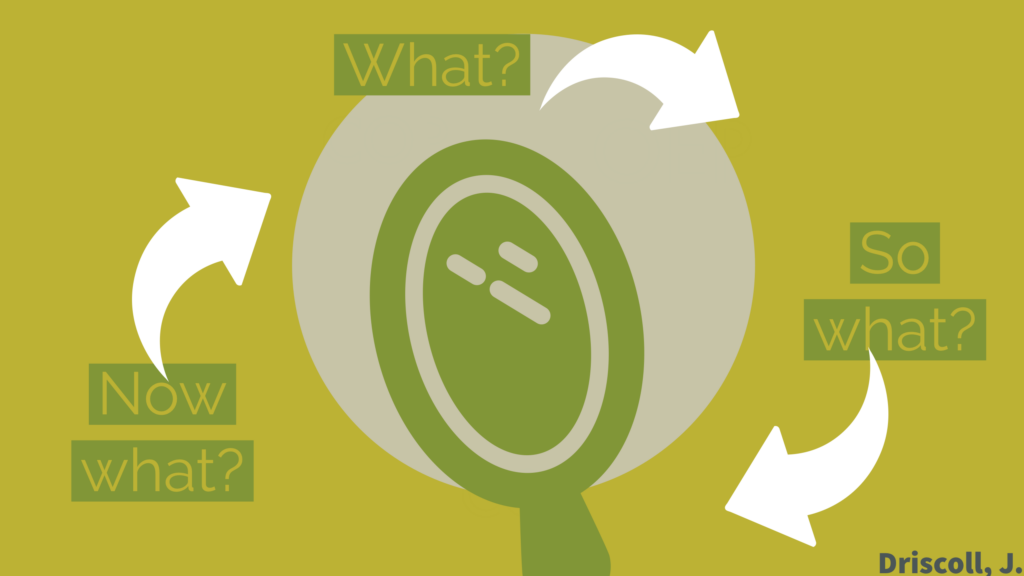
So…. it could be time to make your thinking more visible. Here are four options
- Share your thoughts about your work thus far (privately on Slack) and letting the community see where you are in your DH-OER project.
- Adopting and customising this Google Sites portfolio template, which I adopted from my colleague Paula. And filling in the structure
- Register (or log into ) your wordpress blog. And use Driscoll’s cycle of reflection to think out loud? To guide your thoughts
- Complete the H5P – “Generate a story” exercise below
We can’t all be internet hero’s. Neither do I want to celebrate failure. But I think it might be useful to start thinking about a fail forward methodology. Something for those who want to keep on moving forward. The premise is simple. An individual takes initiative, and with the support of others, they tell their story. Identify what they need to know and are able to move forward through the failure.
DH-OER | What have I seen?

Test your understanding of Copyright and Creative Commons
Exploring your work
I began working with DH OER Champions recently (17 June 2023). I’ve had a wonderful time. Reaching out to people across South Africa . Some who I know directly. Others who were on my Twitter time line (I was very pleased to meet). Others who are longtime ed techie / instructional design colleagues. I’ve met meet both groups and individual project leaders. Found out where these champions are, with their open efforts. Been looking at the outputs. On the whole, I must say I am hugely inspired, by the work I see.
“Imagine a world where every single human being on Earth has free access to the sum of all human knowledge.”
— Jimmy Wales, founder of Wikipedia
In conversations with champions, I’ve seen many possibilities. How they are entering a world with thousands of (other) creative and generous educators, designers, experts, academics etc. This is a world where, with appropriate permissions, we can share and repurpose millions of digital works. That you can use completely, as it suits your class or course.
Many have expressed high expectations for Open Education. I’m hoping, that as we count down to the showcase event in Mid November (please pencil in the 16 November). That this last leg of the journey will be a positive learning experience for all of us us.
A simple recipe for sharing
OER (as you know) are “Educational materials of any kind (e.g., textbooks, worksheets, lesson plans, instructional videos, entire online courses, educational games) which can be freely used, adapted, and shared.” (UNESCO, 2022) What makes an OER an OPEN education resource is the license. Which explicitly gives the users a specific set of permissions. To use the resource. And the most commonly licensing framework is Creative Commons (CC).
Some projects have not explicitly selected a Creative Commons license. And placed it on their materials.
To create a license for your work, simply follow these steps:
- Bookmark the Creative Commons homepage. I’d suggest that you find a way to remember important website addresses. You can create a book mark on your browser to help you to remember this address
- Locate the ‘Share your Work page. Creative Commons have a simple, standardized way to give your permission to share and use your creative work. They have a “chooser” which will help you find out about Creative Commons licenses . And which is right for you
- Applying the chosen license to your OER. When you apply a CC license, you give permission to anyone to use your material for the full duration of applicable copyright and similar rights. This is a serious decision. If you have never licensed your work before. This may be a bit overwhelming. These FAQ can help
Try it and tell us what license you’ve chosen
Much like these blog posts have a CC licensed image (see above). and the whole blog is licensed as CC BY. I’m hoping that you will use the steps above to license your work openly. If you are not familiar with copyright, permissions or Creative Commons. And found the above quiz a bit confusing. Please reach out. Very happy to explain how things work. Or you might try this lesson below about this acronym
T-A-S-L
● Title: The title of your work
● Author: Your name
● Source: A link to or notice regarding where your work can be found
● License: The specific Creative Commons license you’ve chosen for your work
Using TASL
A quick TedEd lesson on creating an licensing statement https://ed.ted.com/on/rUNKOjrY
DH-OER | Are you using Slack?

Check Your Understanding
I’m a believer in the participatory web. You’ll often find me on Twitter. Offering my 2 C worth. But, since Xitter begun to implode (thanks Elon). I’ve began looking to be pro-social elsewhere. Like others; I’ve been wondering. – Where to now? One of the alternatives I’ve been looking at has been Mastodon. Another was Threads – the Instagram related app. But I quickly withdrew (like many others). When I realized that this platform was from the Zuck /Meta/FB stable. Another alternative is Slack.
Since D -H OER are using this collaboration platform. Where communication is supposed to be organized and efficient, with ongoing conversations. I hopped onto the Slack channel (dhoer.slack.com).
Explore Further
There are many people in Digital Humanities who use these collaboration platforms to work together. I’d encourage you to use it to keep in contact with each other or get a quick reply to a question. Yes, Slack is guilty of interruptions that can kill productivity and one’s concentration. So if you are one of those people, who do not want to be interrupted. Then turn your notification off.
Share in a Mission
- If you have not yet joined Slack. Or tried it. Why not login. Update your profile pic. Introduce yourself on the channel.
- If you have enjoyed this Slack community, and want to stretch your wing further. Then look at other organizations using Slack. For example. Meet Amanda Visconti introduces another Digital-Humanities Slack group. And then there’s the Creative Commons Slack Community. Who will be able to assist with licensing advice.
- Or feel free to add your comments about Slack in the comments below.
DH-OER | Who am I?

Introducing
A conversation between Derek Moore and Michael Gallagher (Date: 18 July 2023 Duration: 58 mins).
“But what can a decent man speak of with most pleasure?”
Fyodor Ddostoevsky
Answer: Of himself. Well, so I will talk about myself.
I am pleased to start working on the DH OER Champions project. As a brief introduction to myself, here’s more about who I am on my website – Weblearning.co.za. You can also follow my “open” actions, thoughts and images on Twitter, LinkedIn, Facebook, Flickr, Instagram, Mastodon, YouTube, and Tick Tock.
Honestly, the exciting stuff is not with me. It’s the things that are happening on my PLN. You are welcome to join me and other open educators in this global open learning network. I belong to Creative Commons (CC) South Africa, the CC Global Network, and OE Global.
For those who are associated with DH OER. I’ll be available on Slack and Zoom. I’ll reach out next week to chat on Zoom and then link your DH-OER project to help and support resources. I’m sure I’ll learn a lot from you, and in return, I’ll provide some open experience and expertise to assist you in meeting your target.
From Now (July) to November – you can expect me to
- Reach out directly to project leads and teams in a kick-off introductory virtual meeting. Schedule a time. Please let me know your current project, status, needs, and challenges. You could work through this mentorship charter (to be adapted) if you’d like some help.
- Link together some of the pressing needs (Google Docs draft 1) that you have identified. I’ll find open resources to support your project and team.
- Introduce and ask you to participate in a few missions. You’ll build upon the work that Jako Olivier covered last year. Possible topics include
- Creating, adopting, adapting, modifying and sharing openly licensed education resources (sometimes refereed to as OER’s). Using the 5R’s
- Helpful infographics, decision trees, frameworks or toolkits used for supporting open education practices (OEP). These resources allow for critical inquiry and student agency.
- Introduction to open infrastructure (H5P, WordPress, Moodle). I’ll show you how to make learning materials accessible, customisable, editable and abundant via these platforms. Thus widening access and participation in a course.
- Give examples of how you might tell stories to showcase your OER work, make your thoughts visible and develop your digital footprint.
Showtime: In November, you will submit your finalised work.
In November 2023, we will be organising a virtual event where all the DH OER teams can share their work, the experience and insights gained while developing their OER and discuss their plans for the future. All project teams who complete the programme by November 2023 will receive a certificate of completion.
Please also feel free to reach out and follow me on any of the above platforms I mentioned. I am comfortable in most digital habitats. However, project communication for DH-OER will be via email, Zoom and Slack. A minimum assumption is that “manager-champion” communication will happen from there.
Look forward to chatting soon.