
Understand your “Digital Self”
Yes, celebrate the Jimmy Wales, who started Wikipedia. But let’s not let our desire to be perfect, to be right, to offer the next solution. Get in the way of our of being honest and open.
There are so many reasons why I have “failed” to accomplish what I wanted. Yes, when things go well. I’m happy to attribute my success to my so-called “brilliance”. And when things go badly. I attribute the problems to factors out of my control.
In today’s post want to talk about things going badly. This is a difficult topic. Especially when there is so much pressure to know it all. To be the expert! Offer solutions. But as failforward.org suggests. It is possible to fail intelligently and move forward from the experience, stronger and wiser. But if I want to explore why my plans went pear shaped. Then it’s really important to
- detect my failures early, and speak about them.
- respond positively, and be curious about the situation.
- take smart risks and experiment with new ideas
I’ve enjoyed the chance to connect and converse within this emerging DH-OER community of practice. Connectivism suggests that this is how we learn from each other. Through our networked conversations with peers. Generally, most of us tend to be more comfortable with in person conversations. Or if they are online, then the conversations are one to one, via DM. This is where we can speak safely, about “failures”.
The internet has made the “hivemind” possible. It allows us to be curious. I can tap into a collective consciousness of open educators. And draw from their collective experience of those in my network. I can openly share my ideas or resources. Directly within community of practitioners or my personal learning network (PLN). Rather than rely on employees or paid suppliers.
But commercial ed tech doesn’t really like it when we talk about failures. It prefers to minimize them.
In the DH-OER project, we’ve chosen to locate our hivemind on Slack. So, as we think about connecting to a community of DH-OER practitioners, and the Open education hivemind. I’d like you to do the following
- Think of seven keywords (give or take a few), that you would use to introduce both sides of your digital self to an academic collogue in an online space. Or. if you prefer. You could introduce your project using emojis. Then briefly explain what these emoji’s represent or mean.
- Select a profile photo, to represent your digital-self. Are you happy with an authentic look. Or are you creating a more sanitized version of the digital self. Are you trying to build a brand?
- Name some of the inspiring academics colleagues, that you have never met face to face (f2f). But it seems as if you know them. Is there anything that they do, with their “digital-selves”, that that makes their presence notable.
And then be brave and take a risk! Create a blog for yourself. It does not have to cost anything on wordpress
The formalized “digital self”
Imagine you are about to visit a museum or a gallery. There’s an exhibition you really want to see. In the foyer, the title and description of the exhibition is displayed as a large banner. Underneath, you find a set of brochures with a map that orientates you further to the elements of the exhibition and a brief summary of what can be expected.
As you walk into the exhibition room, you notice that the exhibition contains an ordered and purposeful collection of interesting artifacts. These artifacts tell a broader story about the topic of the exhibition. The exhibit curator, has used a range of different kinds of media, to draw attention to ideas and concepts associated with the artifact itself.
You are offered opportunities to explore a particular collection of artifacts
in depth, or the opportunity to take home a mementoes. Leaving the museum or gallery, you are both moved by what you have seen and intrigued to find out more. You can use WordPress this way
The informal and social “Digital-Self”
Now think about your own house. Before the guests have arrived. There’s the messy bedroom. The unwashed dishes. The floor that needs to be swept. We’re adept on putting on our best faces. Whether it be meeting on Zoom. Sharing images on Instagram. Or posting our witty Twitter comments. A glance at a LinkedIn profile, emails or direct messages on Slack. Its in these connections, that we discover other’s “digital-selves”. But sharing our messy or “failures” openly with the world. Is hard. But not impossible. And if you use WordPress P2 , you can do this safely, with a team.
Thinking out loud
So…. it could be time to make your thinking more visible. Here are four options
- Share your thoughts about your work thus far (privately on Slack) and letting the community see where you are in your DH-OER project.
- Adopting and customising this Google Sites portfolio template, which I adopted from my colleague Paula. And filling in the structure
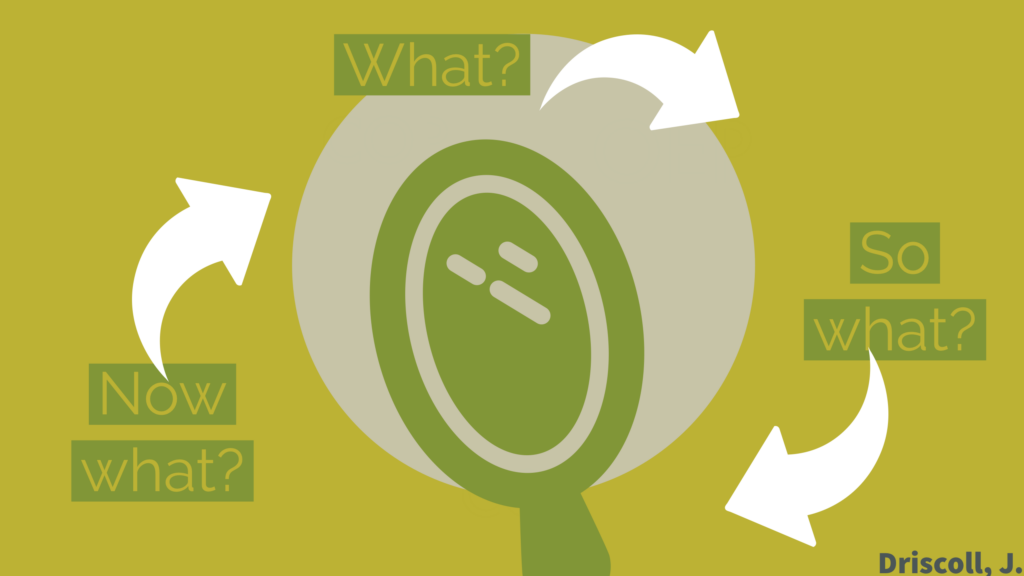
- Register (or log into ) your wordpress blog. And use Driscoll’s cycle of reflection to think out loud? To guide your thoughts
- Complete the H5P – “Generate a story” exercise below
We can’t all be internet hero’s. Neither do I want to celebrate failure. But I think it might be useful to start thinking about a fail forward methodology. Something for those who want to keep on moving forward. The premise is simple. An individual takes initiative, and with the support of others, they tell their story. Identify what they need to know and are able to move forward through the failure.