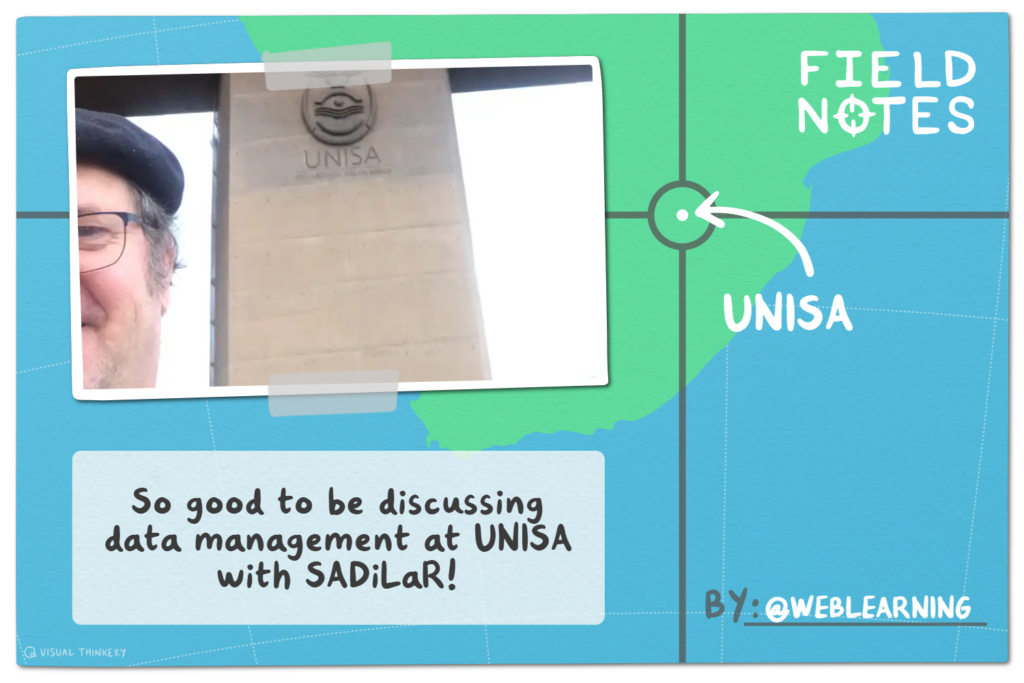
Recently, (4-5 March 2025), I attended the second of SADiLaR’s Data Management Workshop at Unisa, in the Senate Hall. You might remember, I attended a similar workshop last year, where Benito Trollip opened my eyes up to research data management and Bianca Peterson (from Fathom Data) introduced to Open Refine.
Here, with cameras and lights, the Department of Library and Information Services hosted another helpful workshop about “all the materials and assets scholars collect, generate and use in the research cycle” (Harrower et al, 2020). I especially enjoyed meeting a few of the UNISA librarians, including Refilwe Phala, who I would pop in to visit later on, and a Retha Visage’s presentation about the Ethics of Data management.
Thanks to Marita and Benito (and their respective teams), I enjoyed the event (and the company) thoroughly.
At the previous workshop I installed and started to play with Open Refine. It was a fascinating package, but surprisingly, I had no really good source of open data. So I began looking around and suddenly clicked!! Wikidata might be the perfect source. So whether you want to add 100 well sourced statements to Wikidata. Or play around with Open Refine (also available in the Cloud), or to use Open Refine add structured data to Wikimedia Commons (the Commons Extension is helpful). I now had the opportunity to apply the basics of Open Refine for Wikimedia Commons.
A small digression (caused by a new word)
Toponymy was a new word that I learned from Marita (hope I’m right). Toponymy is defined as the study of place names or feature names. Changes to universities, airports, roads, schools, towns, cities etc are common around here. The narratives that go along with spatial changes (in my circle) can be controversial. Some see erasure, others see a principle of correcting historical wrongs (Kalima, 2024).
This talk page on Wikipedia shows how this spatial narrative about placename changes in South Africa is contested in the Wikipedia’s community. The US recently has had to contend with a major placename change and this Wikipedia talk page also shows significant spatial debate.
It was here at the workshop that the topic toponomy was both introduced and inadvertently explored. A sharp eye’d librarian pointed out an odd error on Google’s Info box. Vincent van Gogh’s youngest brother, Cor van Gogh, has the entry “Died 14 April 1900 Winnie Mandela” (see circled in red on the screenshot below). We found that rather odd.

Now yes, “Winnie Mandela” is the new name that Arts and Culture minister Nathi Mthethwa gazetted in 2021. In Brandfort, Thamm (2021) notes, was where the British set up a couple concentration camps, was where Hendrik Verwoerd wrote his matric, and was where Vincent Van Gogh’s youngest brother, died of a gunshot wound, some speculate suicide.
South Africa has a long history of assigning / reassigning place names. This goes back over centuries. Yes, sometimes the reason for placename changes is to remember an important event, person or feature. However the reformation of our spatial narratives are formed by those with political intents and this affects our public memory and a sense of historicity (Chakraborty 2020).
Beth Williamson (2023) suggests that European colonialism renamed places to inscribe their order and meaning, they legitimized territorialization and generated a sense of belonging. Differences in feature names and their meanings are less explored. Remember the story about the Inuit having many words different types of snow. Or isiXhosa has many ways to describe different types of walking.
When I lived in KZN, the Pietermaritzburg-Msunduzi municipal council indicated that they wanted to change some street names in the city to remember those who played a role in the liberation struggle. There was consultation and discussion in the city council about the matter and the names chosen did indeed honour local struggle heroes who played a notable part in the anti apartheid movement. Did this shift anything? For me…no. I was a history teacher at Alex High. Perhaps for others. Learning about some of our struggle hero’s and their history is important. As is learning about colonialism and apartheid.
I did also notice that as local government service delivery deteriorated, the more widespread the place name changes seemed.
“The two work in opposite directions. It’s easier to fix a name than a road.”
Theodorus du Plessis
See what’s happening elsewhere. Go to Google Maps, you’ll find the Gulf of Mexico (Gulf of America) and posting user generated content has been turned off. Pop over to Open Street Maps, there’s an interesting discussion. Go to Wikipedia, and read about the Gulf naming dispute.
These toponomy conversations on Wikipedia and Open Streetmaps about the previous chosen and future placenames offer new layers of understanding about our common heritage that we want to remember and what layers we want to forget. They challenge the map makers and their communities to explore further.
Cor van Gogh, Winnie Mandela, Hendrik Verwoerd. Brandfort has both a significant and painful place in our collective history. Google maps accepts our reviews and thoughts about the current landscape, but does not allow permit increased representative and equitable dialogue about historic landscapes. Google has labelled the Gulf of Mexico (Gulf of America) and posting is turned off. Brandfort is now Winnie Mandela (but you can still comment). Are we really engaging on the effects of placename changes on our spatial memories or our South African heritage. Or are we looking for certainty in a landscape that has changed, and will change and we are just too slow to adjust.
Placename changes is not a uniquely South African matters and I find it helpful to remember, that these patterns happen elsewhere. As the US changes, more accountability sinks are formed, I suggest that further service delivery challenges emerge in the US in the next few years are likely with more gutting / outsourcing. Maybe we will see more US place name changes.
Last reading for the day. Macgilchrist & Jarke (2025) in an article about data and the point out the “visualisations that suggest certainty lie at the heart of many decisions”. These physical colonial maps that we once all had on our Atlases or stuck to out classroom walls. They offered all utopia of certainty.
The assets that we use with Open Refine, to collect, generate and use in our research cycle also offer certainty. I objected to the term “raw data” and suggested that it all data was decontextualized, simplified and quantified (I called it cooked). Annemarie had a helpful suggestion and built on the cooking analogy.
Ingredients can be described in the kitchen as “raw”. However, a lot of pre-processing happened. “Flour” in its rawest form was once maize. Perhaps “processable” is a better way of thinking about structures, semi and unstructured data.
The decolonized place names that we give our Learning Management Systems (eFundi, eThutho, Amathuba or Ulwazi) mask the colonial and corporate powers who run these certainty machines. But some knowledge is situated and uncertainty is welcomed by professionals in medicine, defense and climate change who deal with these uncertain conditions. The certainty that processed (or cooked) data offers on our ed tech dashboards, needs to be questioned. Spotting trends using bar graphs, pie charts may make us feel informed. But not all conditions are that clear.
References
Chakraborty, S. (2020) Branding the Power Center: Toponomy as a Tool for Assertion of Political Prowess (Columbia University).
Harrower, N., Maryl, M., Biro, T., Immenhauser, B., & ALLEA Working Group E-Humanities. (2020). Sustainable and FAIR Data Sharing in the Humanities
Kalima, D. (2024) Name Changes Seen as Plot to Expunge Afrikaans.
Koopman, A. & Dean, J. (2005) New names for old: Transformation in the streets of Pietermaritzburg
Macgilchrist, F., & Jarke, J. (2025). Who said only military officers can deal with uncertainty? On the importance of uncertainty in edtech data visualisations.
Pitas, C. (2025) Trump restricts AP access over Gulf of Mexico Issue
Thamm, M. (2021) Brandfort: Place of hollow forgetting and shallow remembering