On Tuesday and Wednesday (25-26 March 2025), I had the pleasure of attending a key event for those who are interested in Digital Humanities. Entitled “Re-imagining Africa’s Knowledge Futures in the Digital Humanities”. The summit was organized by Dr Denzil Chetty (and the team), who lead the Advancing African Digital Humanities Ideation Hub (AADHIH) at UNISA. The event brought together academics, vendors, policy makers and ed techies, to re-imagine this country’s and the continent’s Knowledge Futures. In person at the Royal Elephant Hotel and Conference Centre and virtually, on UBU (https://www.playubu,ai/).
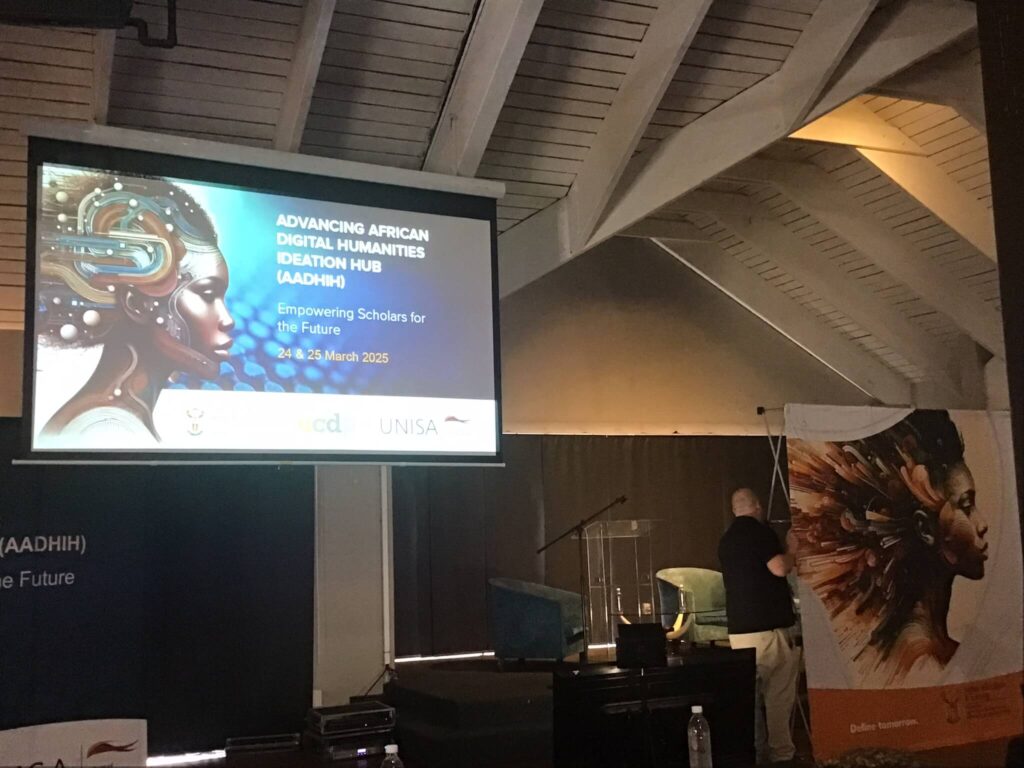
I confess, I arrived late with a lame excuse. I was updating my presentation and lost track of time. This meant that I missed the opening comments and how the two days were framed. Blush. The net result was that I constantly found myself asking…
- Who was going to be doing the re-imagining?
- What are Knowledge Futures?
- Why are we attempting to re-imagine knowledge futures?
I try to be a hopeful technologist, expecting Higher Education (who has been bumbling with the a suite of tools or “solutions” for years) to find a better way to integrate tech into teaching and learning. Don’t get me wrong, I’m also a fellow bumbler.
In many cases, the Learning Management system (LMS) seems to dominate higher education’s online knowledge system. The re-imagining of digital education usually depends on procurement decisions and the LMS is linked to other platforms like
- a student information systems (SIS)
- a customer relationship management system (CRM) or
- an Enterprise Resource Planning system (ERP)
These are crucial technologies for the smooth functioning of the university system. However, the overall result is online learning is limited to the LMS and becomes ….frankly boring.
I get it. Administrators and IT managers prefer a suite of tools that fit . This makes their lives easier and quicker. Academics, who are used to teaching in rooms with walls, floors, boards and data projectors usually don’t want to do the re-imagining either. But this reluctance to change and think differently means that they do not have direct input on the platform and infrastructure choices that have to be made. In my experience, its been the ICT manager, procurement and the digital education team have been doing the re-imagining. Which means that academics do not have a sense of ownership of the many knowledge futures out there.
To me, this summit promised an alternative to common procurement practices that had roots in the Gutenberg Galaxy. Feesmustfall and Covid had had shifted the terrain. Academics, policy makers, ed techies and vendors now had the chance to become involved in decision making that could shape and transform Africa’s knowledge futures. For some, the incentive to transform the infrastructure supporting knowledge futures were the potential revenue streams that could be “controlled, traded, and capitalised” (Kovalainen 2025). For others, the incentive to re-imagine knowledge futures, could be to create “a sustainable resilient learning ecosystems, that enhance social and digital critical literacies, empowering students as active participants in society” (Atenas, 2025). Others might see this re-imagining as a competition to embed AI tools in academia and thus shape how the next generation works with AI as this platform become the default Ai tool. (Robison, 2025). I imagine there were many other agendas.
You’ve also realized that I’m critical of how higher education turns to ed tech and disruption is used to support “transformation”. Then how ed tech it uses the installation of a disruptive platform and the data points it collects to act as evidence of engagement (as if that’s a new future), to justify the change. Its a bit like realizing that gambling has created an addiction problem, and so we look to Casino’s for support. Technology in education has allowed investors, venture capitalists and private equity to reshape education. Don’t look to more technology for answers. They’re no revolutionaries (although they might tumble you).
Transformation is not created by making a technology available and collecting data. Transformation is possible when your own mind shifts or changes, when your practices alter AND when this shift in mindset /practices are materialized collectively. When you and your students can do something significantly different as a result of an ability to manipulate or subvert the technologies in front of them. That’s when transformation can be seen.
Sheila Jasanoff calls the many transformation futures out there “sociotechnical imaginaries” (SI). She defines them as…
“collectively held, institutionally stabilized, and publicly performed visions of desirable futures, animated by shared understandings of forms of social life and social order attainable through, and supportive of, advances in science and technology.
The Sociotechnical Imaginaries Project
Was this summit a better way to go about procurement? Was this about exploring socio technical imaginaries. Or was this just a sales pitch (which was exactly what I was doing with my Spectacular Vernacular presentation). I wish I knew.
Day 1 – Presentations
- A Digital Humanities of Technological Singularity
- The first presentation by Mic Mann had me baffled. The co-ceo of Singularity U South Africa spoke. The singularity group is a prestigious privately funded tech tied think tank from Silicon Valley and started by Peter Thiel and Ray Kurzweil (Tvorun-Dunn, 2022). The group has 80? franchisees / branches around the world. “Singularity” refers to Kurzweil’s utopian moment of superintelligence and Mic was talking up crypto, Web 3 and NFTs on the Metaverse (Curcher, 2023). This socio technical imaginary seemed a bit incongruous for UNISA, an open learning and public university were aligning themself with the exclusive Singularity Group. While I can understanding my hotshot UCT computer science friends getting this information. Most of it, frankly, went over my head (and I suspect over the heads of others).
- A Digital Humanities directed by governance and policy
- The second presentation by Andreia Inamorato was far more measured. She took an European Union perspective (instead of Silicon Valley venture capital angle). With a history in open education, focused on discourse (the discussions and debates) around practices and policies in education and knowledge production. This felt more familiar territory and contained language I could relate to. It felt (to me) a suitable counter point to the first speaker.
- A Digital Humanities of Virtual Reality
- The third presentation was about Virtual Reality and Artificial Intelligence by Jaco Sauter. It rang familiar bells. Substituting a virtual experience for a real one is a familiar computer assisted education technique. I tried it myself when I showed the early internet to my class and a Virtual Frog Dissection. The class always preferred doing a real live dissection, or going on a proper field trip. The Virtual was also technically impressive, and I’d chatted about some of these but the amount of effort necessary to create the experience made it unlikely.
- A Digital Humanities led by AI literate Co-pilots (thanks Microsoft)
- The fourth presentation by Vivian Ladner sat much closer to my comfort zone. I’m a reluctant Microsoft subscriber. I got trapped early on and all my resources are formatted by their suite. Vivian Ladner, their sales person, talked to academics about upskilling ourselves so that we become Ai literate. She did not mention how literacy and power are connected, how social practices and contexts shape us. The presentation looked fun, the subwoofer and speakers amplified the effect. I don’t but the Ai Hype. Most of it is hyperbole. But Microsoft gives confidence and stability, to many who are still new with software. It feels like a game changer.
- A creator and gamer Digital Humanities
- The fifth presentation was made by the VUKA gamers, three UNISA students who showed us how they had created their games. This was up my alley. I love it when students are both knowledgeable and knowledge-ABLE. When they can use a computer for more than drill and practice, for pretty presentations. I like it when they can show others their work and explain the rational for the choice they made. The question I asked them afterwards, was what were they going to do with the game. Add it to a portfolio? Share it with friends.
- A Digital Humanities that was multilingual and mentored
- The sixth presentation was me! Talking about Spectacular Vernacular and using Wikipedia. I’ll post more about this separately.
- A Digital Humanities is context aware, allows for computational thinking to be learned with appropriate media
- The seventh session was by Jean Greyling and the fabulous unplugged coding approach that he has has scaled up. I liked this approach so much that I wrote a Wikipedia Article (still in draft)
- An inclusive and accessible Digital Humanities that used Assistive Tech
- Eight session was was about thinking with and through Assistive Technology. (Confession time: I skipped the session)
- A Digital Humanities enabled via a trailing edge technology – radio
- The nineth and last presentation for the day was about the transformative role and power of radio in Africa. Instead of focusing on the tech, Robin Sewlal, Joanne Joseph, Lumko Mtimde and Franklin Huizies had an engaging panel discussion. It was interesting and informed. As a one time part-time programme manager for Radio Maritzburg, a community radio station that Dave Hotchkiss led. We got the first community radio station license. I appreciated listening to the thoughts of the panel. Conversation (or discourse) still has a place, especially here in this country where many people don’t have a computer or internet access
I left day 1 feeling a bit conflicted. Unisa is an open learning institution, Denzil had made a shift the who in the re-imagining of procurement. We had seen nine knowledge futures, but many of them seemed closed. In the open learning world, you can choose to open up to knowledge futures by looking at a spectrum of open practices. (see Spectrum of Open Practices below). I had not heard the word open being used within all the eight sociotechnical systems. Not much evidence of intentional adapting either, whether it be open textbooks, open source software, or other forms of open education resources. Or perhaps blogging, where I encourage friends to make their thinking visible on FolioFriday.
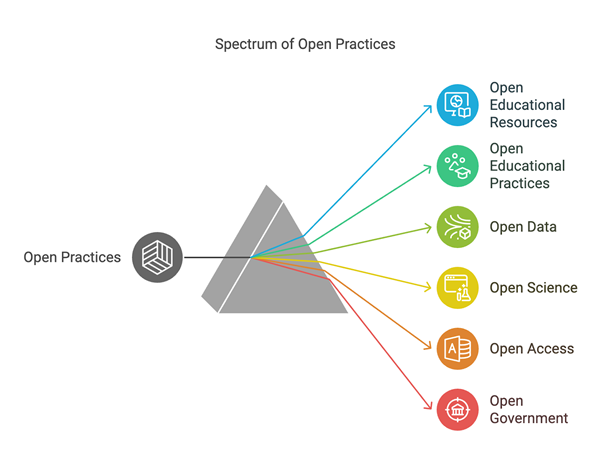
What would Africa’s future knowledge be open? Perhaps Day 2 would reveal all.
Day 2 – Discussions
Determined not to make the same mistake again, I arrived early on Day 2. Sadly, I could not stay the whole day. Had a memorial service for an Alex High colleague in Pietermaritzburg. Bumped into Prof Isobel Schellnack-Kelly, a UNP history class mate of mine, now an esteemed scholar. We chatted and caught up. Her work is in archives sciences. She’s got an ERIC (Education Resources Information Centre) skill set.
As day 2 progressed, I began to figure out the framing that I had missed. Yes, this was a college wide procurement exercise and Unisa academics (and visitors like me), were being exposed to nine possible knowledge futures (on day 1). On day 2, the academics had the opportunity to discuss what they were shown. This was rich and interesting, so much better than a previous experiences with ed tech procurement. This process of looking at different “Knowledge Futures” was more systematic. These socialtechical imaginaries were ascribed value, belief was placed in a few of them, consent perhaps even manufactured?
In summary:
Who was going to be doing the re-imagining?
What are Knowledge Futures?
Why are we attempting to re-imagine knowledge futures?
The event (looking back) presented a variety of sociotechnical imaginaries (on day 1) and then the opportunity for academic discourse about these sociotechnical imaginaries (on day 2) was given. Day 2 was here that we began to explore how to decolonize knowledge, to make it more accessible and socially relevant. These Knowledge Futures were being already framed through a corporate frame. Big brand names, proprietary products. The summit was also a reminder that there is no single higher educational future or one digital humanities. Discourse among all of those who use tech is key a part of the process of procurement. Futures cannot be decided by software vendors (or Wikipedians like me) African Knowledge Futures require academics from Africa, to make what they want the world to be.
Appendix 1 Knowledge Futures
Sian Bayne, Jen Ross, J and Michael Gallagher have put together these eight knowledge futures.
- Enhanced enhancement – technologies and pharmaceuticals have been been rolled out and in education. Smart drugs, AI and emotion recognition technologies are normalized and are on campus to respond to expectations around performance, productivity and benchmarks. Brain data (gathered from cognitive training tools or brain computer interfaces) is also collected and sold.
- The university of ennui – ubiquitous technologies have automated everything. There is un limited access to information and university now focuses on supporting student journeys to fullfillment and happiness (without paid work). The focus is on creative, critical, philosophical and social skills.
- Return to the ivory tower – state funding has declined and inequality has grown to such an extent that only a small proportion can afford a full time campus experience on a gated campus. Universities are no longer engines of social mobility, but a place for influential elites.
- Justice-driven innovation – social challenges (poverty, climate, equality, governance, justice) is foregrounded by community based movements and academia. Universities choose to move away from big tech infrastructure and develop their own open ecoversities. Partnerships between these communities (instead of corporates) are grown and developed.
- Extreme unbundling – outsourced
- The universal university new teaching models and advancements in virtual and augmented realities permit educational simulations and immersive environments
- AI academy – normal academic work (from literature reviews to student assessment) has been usurped by rich data lakes who offer an analysis of historic and behaviour data and comine this with neuro data to catogorize capabilities
- Extinction-era universities – universities operate on an eco bottom line.
Reference
Bayne, S., Ross, J., & Gallagher, M. (1 Jun 2022 – 30 Nov 2025) Higher Education Futures. Available https://www.de.ed.ac.uk/project/higher-education-futures CC BY NC, https://creativecommons.org/licenses/by-nc/4.0/
Curcher, M. (2023) The Pseudo Uni. Postdigit Sci Educ 5, 558–560 . https://doi.org/10.1007/s42438-022-00384-3
Fawns, T. (2022) An Entangled Pedagogy: Looking Beyond the Pedagogy—Technology Dichotomy. Postdigit Sci Educ 4, 711–728. https://doi.org/10.1007/s42438-022-00302-7
Leu, D. J., Kizner, C. K., Cooirco, J., Castek, J., & Hentry, L. A. (2017). New Literacies: A Dual-Level Theory of the Changing Nature of Literacy, Instruction, and Assessment. The Journal of Education, 197(2), 1–18. https://www.jstor.org/stable/26612644
Kovalainen, A., & Poutanen, S. (2025). The state as an agency in the assetisation of knowledge: the case of the Finnish education export. Learning, Media and Technology, 50(1), 75–86. https://doi.org/10.1080/17439884.2025.2450724
OpenAI and Anthropic are fighting over college students with free AI
Robinson, K. (2025) https://www.theverge.com/ai-artificial-intelligence/641193/openai-anthropic-education-tool-college
Tvorun-Dunn, M. (2022) Acid liberalism: Silicon Valley’s enlightened technocrats, and the legalization of psychedelics, International Journal of Drug Policy, Volume 110, https://doi.org/10.1016/j.drugpo.2022.103890.