Blog post to accompany my submission
26-29 /04/ 1994 marked a key date in our country’s temporal knowledge graph (TKG). Nelson Mandela {{Q|8023}} chose to cast his vote at Ohlange High School {{Q|7081074}} located in Natal {{Q|917867}} This rural educational institution was founded in 1901 by John Langalibele Dube {{Q|1700787}} with his wife, Nokutela Dube {{Q|17308980}} when this part of the country was still a colony, known as {{Q|1301901}}
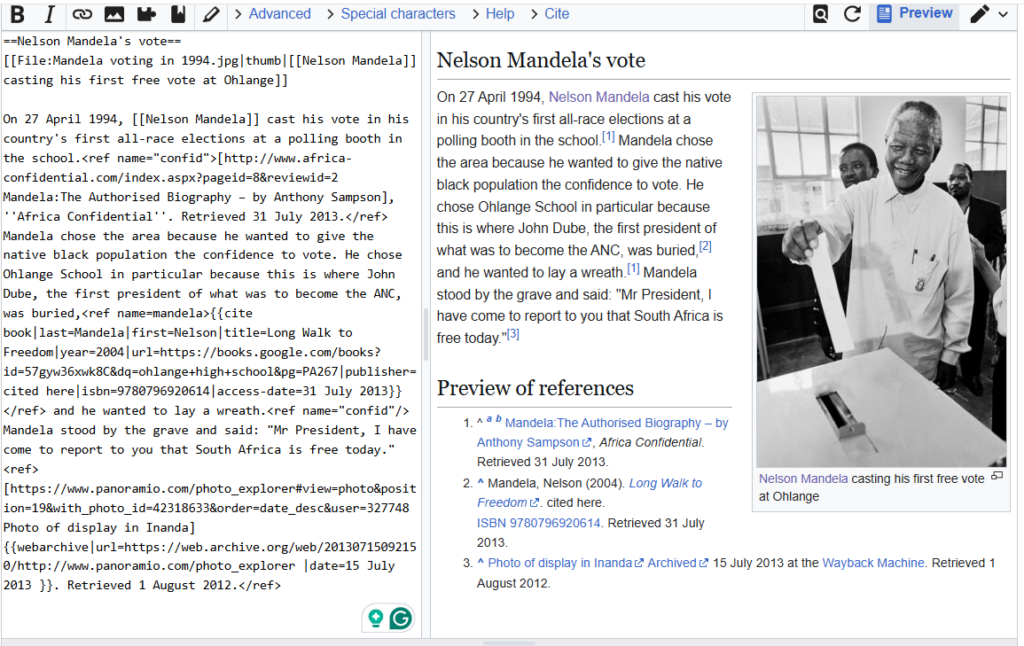
The Wikipedia markup in one paragraph reads (this might change)
[[File:Mandela voting in 1994.jpg|thumb|[[Nelson Mandela]] casting his first free vote at Ohlange]] On 27 April 1994, [[Nelson Mandela]] cast his vote in his country's first all-race elections at a polling booth in the school.
<ref name="confid">[http://www.africa-confidential.com/index.aspx?pageid=8&reviewid=2 Mandela:The Authorised Biography – by Anthony Sampson], ''Africa Confidential''. Retrieved 31 July 2013.</ref>
Mandela chose the area because he wanted to give the native black population the confidence to vote. He chose Ohlange School in particular because this is where John Dube, the first president of what was to become the ANC, was buried,
<ref name="mandela">{{cite book|last=Mandela|first=Nelson|title=Long Walk to Freedom|year=2004|url=https://books.google.com/books?id=57gyw36xwk8C&dq=ohlange+high+school&pg=PA267|publisher=cited here|isbn=9780796920614|access-date=31 July 2013}} </ref>
and he wanted to lay a wreath. Mandela stood by the grave and said: "Mr President, I have come to report to you that South Africa is free today."
<ref>[https://www.panoramio.com/photo_explorer#view=photo&position=19&with_photo_id=42318633&order=date_desc&user=327748 Photo of display in Inanda] {{webarchive|url=https://web.archive.org/web/20130715092150/http://www.panoramio.com/photo_explorer |date=15 July 2013 }}. Retrieved 1 August 2012.
</ref>
You will see that I have highlighted a few parts of the code.
The image and the ticket
File:Mandela voting in 1994.jpg is a photo taken by Paul Weinburg {{Q|83287233}}. The caption from his books reads “Nelson Mandela votes for the first time in his life, Ohlange High School, Inanda, 1994.” Paul attended the same school as me (he was 10 years ahead) and Pessa (his mom ) helped Chris Sexon to produce school plays. I performed in lots of them.
Isla uploaded a few of Paul’s photos to Wikimedia Commons. She must have got permission since the VRT team have been rather strict (I often get zapped).
The Volunteer Response Team manage permissions with {{PermissionTicket}} system. Paul’s permissions number is 2013062010004691 and a login is required to see what other pictures have permissions. The following SPARQL query will allow you to find other photographs that Paul took. https://w.wiki/FyXE .
How to write references on Wikipedia
There are three cited references in the paragraph.
- <ref name=”confid”>[http://www.africa-confidential.com/index.aspx?pageid=8&reviewid=2 Mandela:The Authorised Biography – by Anthony Sampson], ”Africa Confidential”. Retrieved 31 July 2013.. </ref>
- {{cite book|last=Mandela|first=Nelson|title=Long Walk to Freedom|year=2004|url=https://books.google.com/books?id=57gyw36xwk8C&dq=ohlange+high+school&pg=PA267|publisher=cited here|isbn=9780796920614|access-date=31 July 2013}}
- [https://www.panoramio.com/photo_explorer#view=photo&position=19&with_photo_id=42318633&order=date_desc&user=327748 Photo of display in Inanda] {{webarchive|url=https://web.archive.org/web/20130715092150/http://www.panoramio.com/photo_explorer |date=15 July 2013 }}
Wikipedian editors seem to prefer articles that use {Template:Citation}, as used in the second example. References can also be made using <ref> </ref> or you could use use one of these these tool. It’s also a good idea to archive references, as this helps address link rot {{Q|1193907}}. Even so, reference three cannot be seen. This information in this paragraph, on commons and Wikidata is both human and machine-readable.
Unpacking a TKG
Let’s explore this paragraph further. Anthony Sampson {{Q|573976}} became a friend of Mandela {{Q|8023}} in the 1950s. He was asked to edit Drum Magazine {{Q|1135670}} by James R. A. Bailey (aka Jim Bailey) {{Q|13522443}}. They both were British citizens {{Q|131192319}} had attended the University of Oxford {{Q|34433}} and {{Q|573976} rescued the paper, acted as editor from 1951 to 1955, and then went on to work for The Observer {{Q|336197}}. In 1964, Anthony covered the Treason Trial {{Q|1119564}}and reputedly advised Madiba on his moving defence speech from the dock:
“It is an ideal which I hope to live for. But if needs be, it is an ideal for which I am prepared to die”.
Knowledge graphs use “tripples” to establish facts. You will see that there are three components of this small portion of the TKG
- Entitees (nodes): Drum Magazine, Oxford University, Treason Trial and the tangible, real-world objects, places and people
- Relationships (edges): Jim, Anthony and Nelson were connected entities
- Timestamps: A time range where the relationship or event remains valid
Put another way
| Node: | Anthony Sampson | Drum Magazine | Jim Baily | Nelson Mandela |
| Edge: | Citizen of; Educated at; worked for, friend of; Publisher of | Owned by: Target audience: | Citizen of; Educated at; | friend of |
| Timestamps: | 1951, 1964 | 1951 | 1951 | 1951, 1964 |
Look, this is very rough and I’m not quite (yet) an ontology engineer but my ratonale seems to be making some sense. When go to Chat GPT {{Q|115564437}} and ask it this question…its obliges!

Now why don’t you try to prompt your TKG? Here are some suggestions.
– Create a timeline for Anthony Sampson
Who graduated from Ohlange High School and when?
Final thoughts
The quote attributed to Mandela in the above excerpt
“Mr President, I have come to report to you that South Africa is free today.”
might be about respect and going back roots. But Dube’s legacy as the founder of the SANNC is complicated. He was ousted in 1917, he has been claimed by different factions of the liberation party, and the relationship between the ANC and Inkatha was fraught at that time. This seems like hagiography to me. I would insert this preceding phrase, “Mandela was reputed to have said….”
References
Dogan, C. (2024) Temporal Knowledge Graphs. Medium https://medium.com/self-study-notes/temporal-knowledge-graphs
Omar, A. (2024) Mandela was not alone when he made his first vote. Mail and Guardian
https://mg.co.za/thought-leader/opinion/2024-03-06-mandela-was-not-alone-when-he-made-his-first-vote/
Pinnock, D. (2019) Remembering the extraordinary life of SA’s original media maverick. Daily Maverick. https://www.dailymaverick.co.za/article/2019-12-04-remembering-the-extraordinary-life-of-sas-original-media-maverick/
Thompson, J. (2004) Obituary: Anthony Sampson. The Guardian. https://www.theguardian.com/media/2004/dec/21/pressandpublishing.booksobituaries
Weinberg P. (2025) Between the Cracks, p133
Zhu, J., Fu, Y., Zhou, J. et al. A Temporal Knowledge Graph Generation Dataset Supervised Distantly by Large Language Models. Sci Data 12, 734 (2025). https://doi.org/10.1038/s41597-025-05062-0
? (2017) Drum : The Making of a Magazine by Anthony Sampson https://www.uj.ac.za/wp-content/uploads/2021/07/drum-the-making-of-a-magazine-by-anthony-sampson.pdf