A well rounded ed-techie

A well rounded ed-techie’s mission should be to enable / enhance teaching and improve learning using available technologies.  This broad mandate makes the potential scope of work vary wide and quite dynamic. Constantly changing tools and technologies regularly usher in change and create flux. Consequently, good ed techies are not always easily found, or they become difficult to identify. 

Many times, the actual job description of an ed-techie will be vague and unclear. A lack of consistent terminology in the literature and among the profession contributes towards this haziness. If the ed techie is working in a higher ed setting, its likely that the locations will differ, according to each local need. You might find an ed techie within the vertical silos of academic departments, schools and faculties. Or somewhere within the horizontal layers services run by administration, the network or academic development. Ed techies appearance within different spaces also leads to certain reflexive behaviours. If located at the centre, the likelihood of top down command and control culture is likely and the ed techie will follow orders.  Whereas if they are distributed across the institution and are closer to the target group, then needs are most apparent, because they are embeded within a context and agency and dialogue will be a feature of their working style. Maybe ed techies are on contract, remote and off campus entirely, and they can bring an external perspective that highlights how closed and insular campus can be to the part time student.

Three Expectations

The titles, roles and duties of an ed-techie can’t be abstracted and depend on the assigned responsibilities within the organization wherein they located. Whether the ed techie be in an administrator, support, training, instructional design or learning and development position, located in a central unit or working alongside departmental colleagues, there are at least three minimum expectations that you can have of them.

Expectation 1: An informed ed-techie must understand teaching, learning, assessment and administrative practices. He or she is comfortable interacting with subject matter experts (teachers, academics or professionals) and can guide them as they begin to apply their teaching practices to technology. If called on, they should be able to suggest a range of different patterns that might enable/enhance digital learning activities and make environment an active one.

Expectation 2: A knowledgeable ed-techie must be able to explain the rationale that lies behind their approach to technology. He or she can use one or several perspectives to explain or defend their approach. They can draw on dominant paradigms, such as behaviorism, constructivism and connectivism, and use these perspectives to unpack their own and other people’s use ed tech. They are also able to identify some of the theorists behind these traditions (from Skinner to Pappert to Siemens) and have read their work.

Expectation 3: A tech savvy ed-techie must be able to manage the use and support of current and new technology resources. He or she is often called into resolving complex issues, consult with vendors, identify ‘solutions’, make recommendations and liaise between all parties concerned. Sometimes they are given the authority and budget to reshape the typical practices of academics and students.

Seven Characteristics

You’ll find the informed, knowledgeable and tech savvy ed-techie in a variety of locations, called upon to do needs assessments,  talking about change, designing training programmes, distributing “how to” recipes and developing and maintaining  “why do we” explanations for colleagues. There are a range of titles to describe the functional roles associated with the work that they do. When hiring an ed techie to fill a role, instead of  trying to match titles to responsibilities, check for common characteristics of a person involved in the intersection between teaching, learning and technology While the post has thus far highlighted the many differences, there are certain attributes or characteristics that seem common to well rounded ed-techies 

  • Practical. They are able to apply their knowledge about technology and pedagogy to address a  particular challenge.
  • Grounded. They can articulate (or at least point to) some of the theories or frameworks  that inform their approach.
  • Up to date & informed. They remain current and interested about a range of emerging and ongoing themes that pertain to digital capability and teaching excellence.
  • Connected. They are either participating in or building their own personal learning network. They lurk within or contribute to a community of practice.
  • Inclusive. They are aware of the digital divide and the make choices that promote inclusivity, diversity and equity.
  • Reflective. They are critical about their own and others’ practices and processes and share their reflections with others.
  • Busy. They are juggling multiple roles. From help desk to researcher, they have their thumbs in many pies

Educational technology is becoming ubiquitous. But ed-techies who are comfortable “working in a ‘third space’ that crosses complex boundaries – between the pedagogical and technological, and the academic and professional” (Mitchel, 2017) are not as frequent. The rapidly changing landscape of digital higher education compounds this problem. The result is a disconnect between ed-techies titles and the actual expertise, attributes, abilities and knowledge needed. This frequently results in confusion and tensions.  Addressing this disconnect is necessary to  improve the relationships and collaboration between ed techies and other people who they work with. If ed techies are to make significant contributions to technology and education, then they need to be valued, supported and empowered. 

References

Intentional Futures (2016). Instructional design in higher education: A report on the role, workflow, and experience of instructional designers. Intentional Futures. Retrieved from https://intentionalfutures.com.

Mitchell, K., Simpson, C. & Adachi, C. (2017). What’s in a name: the ambiguity and complexity of technology enhanced learning roles. In H. Partridge, K. Davis, & J. Thomas. (Eds.), Me, Us, IT! Proceedings ASCILITE2017: 34th International Conference on Innovation, Practice and Research in the Use of Educational Technologies in Tertiary Education (pp. 147-151).

Library – Gamebox – Hub.

The library-gamebox-hub

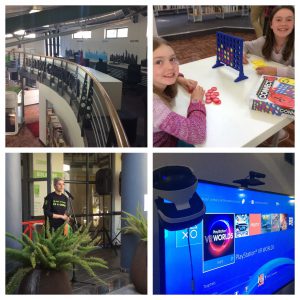
My girls and I attended the opening of the Goethe Institut’s newly refurbished Library – Gamebox – Hub last Saturday (29 July). The space is as beautiful as it ever was with books, magazines, films, music and children’s literature in different languages. But as the name implies, the existing library has two new additions.

The first is a “Gamebox” This room allows visitors to try out the latest from the world of video games. Currently seven computer games that won a gaming prize in Germany, as well as a variety of gaming consoles, an ultra-high definition screen and Virtual Reality equipment are available. I tried the VR set and chose a shark attack experience that put me inside a shark cage with beautiful sea creatures swimming around and also a rather scary bar biting bit

The second major addition is the ‘hot desk’ hub. Situated above the issue desk and offices, on a gallery, this area has eight fully equipped workplaces for creative entrepreneurs, who are working on tech-driven creative start-ups, to work in. Until 31 August, interested individuals and collectives can apply to move into the hub for a defined period of six months. Applications for the hub can be handed in on Deadline is 31 August 2017.

My girls and I enjoyed the opening. This refurbishment is impressive. The library has been augmented.  None of the reading and information resources have been replaced. But a clever re-arrangement of structures and better use of space has introduced the new opportunities that patrons can take advantage of when visiting the Goethe library. We are looking forward to popping in again.

Disclosure: I work in conjunction with the Goethe-Institut as a consultant.

Our first mLiteracy Workshop

I spent two days on the east rand, working with Ekurhuleni librarians and running a pilot workshop about mLiteracy. We set out to explore what is enabled by the combination of free WiFi and mobile devices. We wanted librarians to become comfortable with using their mobile devices in a library setting. Connecting devices is not always easy. Digital skills are required Our focus was on accessing early reading resources that were produced by social publishers. We wanted to show them how these digtitized and freely available story reading materials could be accessed and then used in their library programmes. Entry to the workshop was open to anyone from the region. All they needed to do was fill in a form and take a “shelfie”.


Working alongside this group of librarians was very satisfying. They were very interested in using mobile devices within their scope of work. Participants seemed to enjoy the experience. Comments about the workshop included “I’ve learned a lot of things I didn’t even know about”; “the Workshop was excellent”, “liked the informal and fun way the workshop was presented” and “this workshop should be done regularly to keep us updated.”

A large part of the programme was focused on making librarians comfortable with change that accompanies any innovation. While many workshop participants welcomed the introduction of new technologies into a library, there are some who are wary of the unintended consequences of a mobile friendly library space.

The workshop was designed to allow space for questions, opinion and doubt. Activities like “Emoji Tracker Cards” – an ongoing feedback exercise that offered participants to express their reactions,  “Hopes and Fears” – a process of articulating both positive and negative sentiments about technology and “Shades of opinions” – a set of opinions about changes in the library, allowed participants the opportunity to become comfortable with each other and the workshop programme*.

The workshop was a pilot. I’m hoping that senior management within library services will see the value in it and offer #mLiteracy learning opportunities to more librarians. If you are interested in keeping up with the project, please find us on Twitter or FaceBook. If you are interested in attending, please join our mailing list.


*A participants workbook will be available to all participants.

My sister-in-law and an ed tech qualification

ed tech graduate
Looking for an ed tech qualification.

My sister-in-law asked me to recommend a few post-graduate ed tech programmes. She’s in publishing, a director of a department that straddles continents, has over 20 years of solid educational experience and lives in Cape Town. Seeking to extend her education expertise in a digital direction, she asked me for advice. I took her seriously.

Many South Africans are doing interesting things within the digital and education space. I try to keep up-to-date with their efforts via their Tweets, blog posts, Facebook entries, conference presentations and papers. I find myself inspired by their practices, thoughts and innovations. But when it comes to tertiary ed-tech courses, I hit a blank wall.

I posted a request for assistance about ed-tech options on the Learning, Facilitation & Technology Facebook page and many replied (thanks particularly to Gerrit). Much as I thought, there are local universities that offer post graduate courses options that pertain to ed tech. Here are a few of their official pages on their university websites.

On a computer education course, there must (I assume) be online learning activities that pertain to the creation, use and re-purposing of  educational resources. Or there would be students reflecting on their own teaching practices or responding to fellow students. I don’t know. I can’t really see what’s going on, check out their digital activities or examine student or recent graduates work.

Many colleagues and peers are involved in these courses. But I can’t make an informed comment about the suitability of a course because they are closed.  I’m not so bold to suggest what should go into their various courses or insist on complete open education practice. But I do think that student learning will be enriched if they are encouraged to engage with other parties beyond a course and reflect in open spaces to the challenges that they have encountered. Ed tech pedagogies and practices become better when you know that others are looking. Open courses inspire, they encourage others to experiment and innovate. Open courses also allow students / graduates to be connected with established professionals and lurk/contribute towards a COP. Post graduate ed techies should be encouraged to walk their talk and adopt elements of the read/write web to “deliver” and “share” their digital education experience.

Multimedia. Cognitive tools. Online assessment. Post graduate ed tech courses offers scope for learning by doing. Creation, collaboration, reflection. It’s probably happening within some of the course modules. A computer based course makes it possible for you to show others that you can use computers and do new things (or innovate). But you do have to be brave enough to do this out in the open. Good ed tech programmes and courses need to be more open and be brave enough to accept some scrutiny.  Ideally, I would like to see students responses, reflections, demonstrations etc. appear in a domain of ones own or an eportfolio. But it doesn’t have to be this way. Lectures, create a course hashtag, open up an embedded YouTube page or encourage students to create a curated set of resources. I’m not asking for complete access all the time. But it would be nice to see a little more than I can see at present.

I emailed my sister-in-law a few local links to programmes. I also sent her a few international leads. She connected with graduates from an international course, she checked out their work, liked what she observed, saw that it could meet her needs and enrolled in a course. Without open pedagogies and open practices here in South African courses, ed techies (like myself) remain fairly clueless and unable to sign up or recommend programmes that will meet their (and their sister-in-laws) ed tech professional development needs. It’s time for ed tech courses to become a bit more open.

Shades of Opinion

What will free Wi-Fi enable in a library?

Free Wi-Fi is no longer a novelty. Across South Africa it’s becoming easier to turn off your data in restaurants, malls, banks and petrol stations. Local governments in Gauteng still remain the most generous provider.  At 300 MB of free data per day, a committed data guzzler can save 9GB worth of data bundles every month.

In libraries, the “no phone signs” are disappearing as many realize that the combination of Wi-Fi and mobile phones are attracting new patrons. Greater visitor numbers are not the only benefit. Members of library communities, equipped with their own feature or smart phone, can learn how to make productive use of information. Many librarians recognize the need to support their local communities technology aspirations. Access to data also offers a library community a new opportunity to develop digital capacity and a route to digital inclusion.

E-books on mobile devices can be positioned as a threat to reading. My perspective is that the two compliment each other. They enable a digital reading experience. Over the last year (with generous support from the Goethe Institut), I’ve been working on a programme to enable librarians become more comfortable with working in a data rich and phone friendly library. Together, we are asking how librarians and their patrons can they take advantage of a data surplus and their own mobile devices to access e-books, audio-books, newspapers, social publishing projects and other forms of digital information.

To stimulate discussion around the changing roles of librarians and to unpack how a library user feels about these changes in a library, I’ve created a collection of cards 10 called “shades of opinion”. Numbered 1 to 10, each card highlights a common opinion about change in a Gauteng library.  The cards offer a librarian the opportunity to gauge their colleagues or library patrons opinions. The “shades of opinion” cards can be used as the basis for engagement or discussion. There’s no right or wrong answer. If you want to take this conversation online, please do, The cards are also available on Instagram. I’d be interested to hear what the various responses are.

Plickers Poll

For the participant

Using Plickers cards, a useful polling tool that can be used in a setting that has limited access to technology, you will be asked to respond to 10 statements pertaining to the changes that have been introduced.

For the facilitator

The following equipment is necessary.

  1. Plickers App installed on the facilitator’s device
  2. Preloaded questions via the Plicker website
  3. Participants should be issued with their own Plickers card

The facilitator will show the first of the 10 #shadesofopinionissues about mobile phones in a library setting.
Participants will respond to the issue and choose a response using the scale below.
Rotate Plickers cards and put the letter that corresponds with their answer on top.
Using the Plickers App, the workshop facilitator will scan responses.
Repeat these steps till the 10 questions are answered.

Scale

A = Agree; B = Perhaps; C = Unsure; D = Disagree

  • If you cannot select one of the four options, you should abstain from showing your plickers card.
  • You should discuss the opinion, but may not speak out loud your position until all have voted.
  • When the Plickers card is not being used, place it face down in front of you.

Book Dash Jozi

Book Dash aims to gather creative teams together to write, illustrate, edit and produce a children’s story, in 12 hours. These stories are licensed as creative commons works, which means that anyone can print and distribute these beautiful children’s books, for free. The intention is that the books get into the hands of those who need to access reading materials, but can’t afford to buy a children’s book.

What was I doing there? I can’t claim any great story-making skills, but I can do a bit of stuff with computers, so I got to be the tech director and made sure that scanners, printers, Wi-Fi, power and other technologies worked as they should of. Producing a book is not for the faint of heart. There were many exhausted illustrators at the end of the day. I think that they’ve almost recovered from this book creation sprint – or was it a marathon? Whatever! All enjoyed the day thoroughly. To let you get a sense of the event, I’ve created a Bookdash Storify as a record of the day.

10 Red Flags: Things to know before you go…

red flags
Warning: Consider the following 10 flags before climbing up the ed tech ladder

Some advice from below to my ed techie friends above. Career climbing involves risky routes. Without clear boundaries, an unending 24/7 passage awaits the enthusiastic networked sherpa. The online world, with all its advantages, has little respect for the traditional pathways that once characterized the standard 9-5 job.

Watch where you place your feet. Before moving anywhere, inspect the stability of the ground. In this any-time any-place world, make sure that you know the up and coming terrain. Slipping unexpectedly where the tread is uneven or unsure can be sore. Be aware. Read the warning signs. Notice the red flags before you press on upwards and apply for a new position.

The flags relate particularly to eLearning positions in an academic environment. But they might apply elsewhere. Before you fill in that application form, ask yourself these 5 questions.

  • Flag 1: Why is the position vacant?
    How long was the previous incumbent in the advertised position? Are other potential colleagues in acting positions? How long has senior management been there? Have there been unexpected departures or a high staff turnover?
  • Flag 2: Are you going to be working for a boss?
    Bureaucrat, boss or leader? Does the head of the academic unit have any credibility among his/her academic peers? What does his/her academic profile look like? Have you spotted his/her digital footprints? Don’t be confused by his/her electronic puffery. Expect at least a national leader with peer recognition and academic substance.
  • Flag 3: Does the institution understand their users?
    What’s it like from the bottom up? Pretend to be a student who has lost a password. Phone the helpdesk with a query. See how they respond. Find out what the LMS is called. Then search for mentions on Twitter. Look for support materials authored by the unit. Are there genuine attempts to communicate urgent information to all students, academics, support etc?
  • Flag 4: Does the unit make regular attempts to communicate with their stakeholders
    How transparent is the unit/department? Website? Social Media Account? What’s the balance between marketing and communication content? Any recent collaborations within the institution or beyond? Do they disclose any details or are they just releasing press statements?
  • Flag 5: Do the people that work there make attempts to reflect and research their practice?
    Can you find blog posts, academic policies, peer reviewed journal articles or conference paper pertaining to the unit’s focus? Check out the advert again. What’s the job focus? Combine the focus with the institution’s name on Google scholar. Any papers? Any substance? If they are thinking and researching their work, then they’ll be sharing it with others and glad to share with you.

My listicle consists of 10 red flags. The first five (see above) are for ed techies to consider before they take the job. And the second five (to be added later) are intended for shortlisted ed techies, considering whether they should move on up and accept the job offer.

Next five flags will follow